
Introduction
There’s something uniquely wonderful about owning a large dog. The big paws. The enthusiastic greetings that nearly knock you over. The way they think they’re lap dogs despite weighing 80 pounds. But here’s something every large breed owner learns pretty quickly: feeding a big dog isn’t as simple as just buying more of whatever’s on the shelf.
Finding the best dry dog food for large dogs is genuinely different from finding food for smaller breeds. Large dogs have specific nutritional requirements around joint health, bone development, caloric density, and digestive capacity that standard adult formulas simply don’t address. Get it wrong long-term, and you can contribute to joint problems, obesity, and even heart issues.
I’ve worked with large breed owners for years, and the food question comes up constantly especially with breeds like German Shepherds, Labrador Retrievers, Golden Retrievers, Rottweilers, and Great Danes, where the stakes around joint and skeletal health are particularly high.
This guide covers everything you need, what large dogs specifically need nutritionally, which formulas consistently deliver it, and how to choose confidently for your specific big-breed companion. Let’s dig in.
Why Large Dogs Need Specialized Dry Dog Food
Here’s the thing most general dog food guides gloss over: large and giant breed dogs aren’t just bigger versions of small dogs nutritionally. Their bodies work differently, age differently, and have genuinely distinct vulnerabilities that food can either protect against or worsen.
Joint Health Is a Non-Negotiable Priority
Large breeds are significantly more prone to orthopedic conditions like hip dysplasia, elbow dysplasia, and osteoarthritis than smaller dogs. Their heavier body weight puts more mechanical stress on joints over a lifetime which means what they eat matters enormously from puppyhood onward.
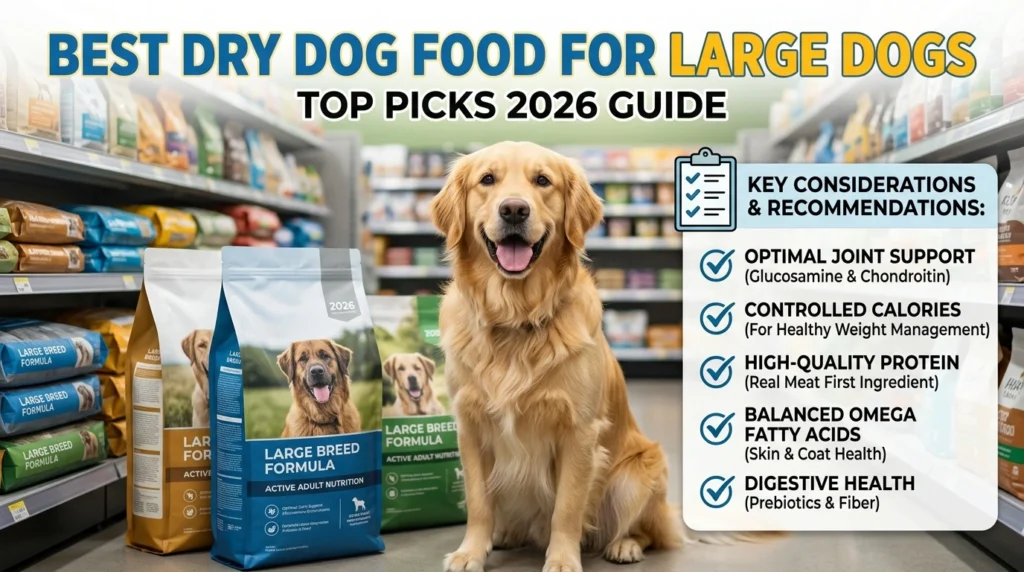
The best dry dog food for large dogs contains glucosamine and chondroitin compounds that support cartilage health and joint lubrication. These aren’t just nice extras. For large breeds, they’re essential preventive nutrition that can meaningfully delay or reduce the severity of joint problems.
Omega-3 fatty acids (particularly DHA and EPA from fish oil) also play a significant anti-inflammatory role in joint health, another ingredient to actively look for on the label.
Controlled Calorie Density Prevents Obesity
Large dogs that carry excess weight put dramatically more strain on their joints and cardiovascular system. And large breeds can gain weight quickly if fed a calorically dense food without careful portion control.
The best dry dog food formulas for large breeds are calibrated with appropriate caloric density enough to fuel a bigger body without encouraging fat accumulation. Many large breed formulas are slightly lower in fat than standard adult foods for exactly this reason.
Calcium and Phosphorus Ratios Matter Especially for Puppies
This one’s particularly critical for large breed puppies. Too much calcium during development can accelerate skeletal growth faster than joints and supporting structures can handle contributing to developmental orthopedic disease.
Large breed puppy foods are specifically formulated with controlled calcium-to-phosphorus ratios that support steady, appropriate skeletal development. Never feed a large breed puppy a standard puppy formula. The calcium levels are different and can genuinely cause harm over time.
Kibble Size and Digestive Rate
Ever noticed how large dogs can inhale a bowl of food in what feels like two seconds? Large breeds are more prone to bloat (gastric dilatation-volvulus or GDV) , a life-threatening condition where the stomach fills with gas and can twist. While food alone doesn’t cause bloat, larger kibble size slows eating and reduces air intake, which is one reason large breed specific formulas use bigger kibble shapes.
How to Choose the Best Dry Dog Food for Large Dogs: Step-by-Step
Ready to find the right food for your big dog? Here’s exactly how to approach it:
- Confirm your dog qualifies as “large breed.” Large breed is generally defined as dogs expected to weigh 50 pounds or more at adult weight. Giant breeds (over 100 pounds Great Danes, Mastiffs, Saint Bernards) may need even more specialized formulas. Knowing where your dog falls helps narrow options immediately.
- Matching the formula to the life stage is critical for large breeds. Large breed puppy food, large breed adult food, and large breed senior food have meaningfully different nutrient profiles. A large breed puppy eating standard adult food misses critical calcium-ratio control. A senior large breed eating puppy food gets far too many calories. Life stage matching is non-negotiable.
- Look for glucosamine and chondroitin on the label. For large dogs, this isn’t optional, it’s essential preventive nutrition. Look for at least 400mg of glucosamine per kilogram of food. The label should state these compounds are added, or note that they’re naturally occurring from chicken or fish ingredients.
- Check the first ingredient is a named protein. Large dogs need quality protein to maintain muscle mass, especially important as they age. Look for chicken, beef, lamb, or salmon as the primary ingredient, not corn or a vague “meat” derivative.
- Evaluate caloric content relative to your dog’s activity level. A highly active 80-pound working breed has very different caloric needs than an 80-pound couch-loving senior Labrador. Check the kcal/cup on the label and calculate your dog’s daily needs. Your vet can help with this.
- Look for kibble size appropriate for large breeds. Most large breed formulas use larger kibble to slow eating and promote chewing, which aids digestion and reduces bloat risk. If the kibble looks the same as a small breed food, that’s worth noting.
- Research the brand’s recall history and quality controls. Spend a few minutes checking the FDA’s pet food recall database for any brand you’re considering. Consistent quality control is especially important for large breeds where health complications from poor nutrition compound significantly over their lifetime.
- Consult your vet for personalized guidance. If your large breed dog has existing joint issues, weight problems, or a breed-specific health predisposition, your vet’s input on the specific formula is invaluable. They know your dog’s individual health profile in a way no article can fully account for.
Pro Tip: For large breeds prone to bloat (Great Danes, Weimaraners, Standard Poodles, German Shepherds), feed two smaller meals per day rather than one large meal, avoid vigorous exercise within an hour of eating, and use a slow-feeder bowl. These simple habits reduce bloat risk significantly alongside choosing a large-kibble formula.
[Best Dog Food Senior Dogs Real-Life Experience With an Older Dog]
Best Dry Dog Food for Large Dogs in 2026: Full Comparisons
Here’s how the top large breed dry dog food options stack up across key criteria:
| Brand & Formula | Price Range | First Ingredient | Glucosamine | Joint Support | Best For |
| Purina Pro Plan Large Breed Adult | $$$ | Chicken | Yes | Strong | Overall best large breed nutrition |
| Hill’s Science Diet Large Breed | $$$ | Chicken meal | Yes | Strong | Vet-recommended daily feeding |
| Royal Canin Large Adult | $$$ | Chicken by-product | Yes | Excellent | Breed-specific precision nutrition |
| Iams Large Breed Adult | $$ | Chicken | Yes | Moderate | Budget-friendly solid option |
| Blue Buffalo Life Protection Large | $$$ | Deboned chicken | Yes | Good | Natural ingredient focus |
| Purina ONE Large Breed Adult | $$ | Chicken | Yes | Good | Mid-range quality-value balance |
| Merrick Large Breed Real Chicken | $$$ | Deboned chicken | Yes | Good | High protein, active large breeds |
| Orijen Large Breed | $$$$ | Free-run chicken | Yes | Excellent | Maximum ingredient quality |
| Wellness CORE Large Breed | $$$ | Deboned chicken | Yes | Good | High protein, grain-free option |
| Hill’s Science Diet Large Breed Senior | $$$ | Chicken meal | Yes | Excellent | Aging large breed dogs 6+ |
My Honest Top Picks for Large Dogs

🏆 Best Overall: Purina Pro Plan Large Breed Adult (Chicken & Rice)
This is the formula I’d choose first for most healthy large breed adult dogs. Real chicken leads the ingredient list. Glucosamine and EPA are specifically added for joint support not just as incidental ingredients but as targeted additions. The formula is backed by Purina’s extensive nutritional research, and it’s consistently one of the most recommended large breed foods by veterinarians. The larger kibble size promotes healthy chewing and eating pace. Available almost everywhere, which is a practical bonus when you’re buying 30–40 pound bags regularly.
💰 Best Value: Iams Large Breed Adult
If the Pro Plan price point stretches your monthly budget, Iams Large Breed is a genuinely solid alternative. Real chicken first, added glucosamine and chondroitin for joint health, and a formula specifically calibrated for large breed caloric needs. It’s not as research-heavy as Purina Pro Plan, but for a healthy large breed dog without specific health issues, it delivers reliable daily nutrition at a more accessible price point.
🔬 Best Vet-Recommended: Hill’s Science Diet Large Breed Adult
Hill’s brings the same clinical rigor to their large breed formula that makes their other lines vet favorites. Natural sources of glucosamine and chondroitin, omega-6 and vitamin E for skin and coat, and a digestibility profile verified through feeding trials. This is particularly strong for large breeds with any history of joint sensitivity or for owners who want a formula with robust clinical validation behind it.
🏅 Best Premium Pick: Orijen Large Breed
If you want the absolute best ingredients money can buy for your large dog, Orijen Large Breed delivers. Around 85% of ingredients from animal sources include free-run chicken and turkey, wild-caught fish plus naturally occurring glucosamine from quality animal inclusions. The protein level is high, supporting exceptional muscle maintenance in large, active breeds. The price is significant, but the ingredient quality is genuinely unmatched.
👴 Best for Senior Large Dogs: Hill’s Science Diet Large Breed Senior 6+
Large breeds age faster than small breeds; a seven-year-old Great Dane is significantly more “senior” than a seven-year-old Chihuahua. Hill’s Senior 6+ is specifically formulated for the accelerated aging of large breeds, with enhanced glucosamine and chondroitin for aging joints, controlled calories for less active senior metabolism, and antioxidants to support immune function. For any large breed dog reaching middle age, this is worth discussing with your vet.
Critical Mistakes Large Dog Owners Make With Dry Food
These are the errors I see most often and they’re very worth avoiding:
Feeding a Standard Adult Formula Instead of Large Breed Specific
This is the number one mistake. Standard adult dog food doesn’t account for the specific joint support, calorie calibration, and calcium considerations that large breeds need. The difference between a standard adult formula and a large breed adult formula isn’t just marketing, it’s meaningful nutritional adjustment. Always use a formula specifically designed for large or giant breeds.
Underestimating How Quickly Large Breeds Gain Weight
A couple of extra scoops here and there adds up fast on an 80-pound dog. Large breeds that carry excess weight experience significantly accelerated joint degeneration; the extra pounds multiply the force on hip and elbow joints with every step. Measure every meal carefully. Use a proper measuring cup or, better yet, a kitchen scale. And reassess portion sizes as your dog ages and their activity level changes.
Skipping the Large Breed Puppy Formula
If you have a large breed puppy, this one is especially important. Feeding a standard puppy food to a large breed puppy delivers too much calcium and too many calories, which accelerates skeletal growth faster than connective tissues and joints can develop appropriately. This can contribute to developmental orthopedic disease conditions that are largely preventable with the right food. Always use a formula specifically labeled for large breed puppies until your dog reaches full skeletal maturity (typically 18–24 months for large breeds, up to 24–36 months for giants).
Ignoring Signs of Joint Discomfort
If your large breed dog is showing stiffness after lying down, hesitation on stairs, or reduced enthusiasm for activity their food may not be providing adequate joint support. These early signs of joint stress are worth both a vet visit and a food evaluation. Transitioning to a formula with higher glucosamine, chondroitin, and omega-3 content can sometimes make a significant observable difference. But always consult your vet first rather than self-diagnosing.
Feeding Once a Day
One large meal per day increases bloat risk in large breeds, especially deep-chested breeds. Splitting daily food into two meals reduces the volume in the stomach at any one time and decreases the risk of dangerous gas accumulation. It also typically improves digestion and energy distribution throughout the day.
Pro Tip: Large breed dogs often benefit enormously from adding a fish oil supplement to their dry food even if their kibble already contains omega-3s. The additional EPA and DHA from a quality fish oil can provide meaningful extra anti-inflammatory joint support. Ask your vet for an appropriate dosage for your dog’s weight before adding any supplement.
Frequently Asked Questions About the Best Dry Dog Food for Large Dogs
1. At what weight does a dog qualify as “large breed” for food purposes?
Generally, dogs expected to reach 50 pounds or more at adult weight are considered large breeds for nutritional purposes. Dogs expected to reach 100 pounds or more are typically classified as giant breeds and may need even more specialized formulas particularly as puppies, when calcium and caloric control is most critical. If you’re unsure where your dog falls, your vet can help based on breed standards and your individual dog’s growth trajectory.
2. How much dry food does a large dog need per day?
This varies based on your dog’s exact weight, age, activity level, and the specific food’s caloric density. As a general starting point, most large breed adult foods recommend roughly 3–5 cups per day for dogs in the 60–90 pound range but always check the feeding guidelines on your specific bag and use kcal/cup to calculate more precisely. Your vet can give you a personalized recommendation based on your dog’s body condition score, which is more accurate than weight alone.
3. Is grain-free dry food a good choice for large dogs?
For most large dogs no, and there’s an important safety reason. The FDA has been investigating a potential link between grain-free diets (particularly those high in peas, lentils, and legumes) and dilated cardiomyopathy (DCM) , a serious heart condition. Large and giant breeds are already at elevated cardiac risk compared to smaller breeds. Unless your vet has specifically recommended grain-free for a diagnosed grain sensitivity, grain-inclusive large breed formulas are the safer, more clinically supported choice.
4. When should I switch my large breed dog to a senior formula?
Large breeds age faster than small breeds, and the transition to a senior formula typically happens earlier than most owners expect. Most large breed dogs benefit from a senior formula starting around age 6–7, compared to age 7–10 for smaller breeds. Giant breeds may benefit from senior nutrition even earlier sometimes from age 5. Signs that a senior formula might be appropriate include reduced activity, stiffness, weight gain, or changes in coat quality. Discuss the timing with your vet at annual check-ups.
5. Do large dogs need glucosamine supplements if their food already contains it?
It depends on the amount in the food and your dog’s individual joint health status. Most large breed dry dog foods contain glucosamine, but the amounts vary. For a young, healthy large breed dog, the glucosamine in a quality large breed formula like Purina Pro Plan or Hill’s Science Diet is often sufficient for preventive support. For older dogs, dogs with diagnosed joint conditions, or very active working dogs, additional supplementation may be beneficial but please consult your vet for appropriate dosing before adding any supplement. More isn’t always better with joint supplements.
6. What’s the best dry dog food for a large breed with a sensitive stomach?
Purina Pro Plan Large Breed Sensitive Skin & Stomach is specifically formulated for large dogs with digestive sensitivity salmon as the primary protein, easily digestible rice as the carbohydrate base, and prebiotic fiber for gut health, all in a large breed formula with appropriate glucosamine and calorie content. Hill’s Science Diet Sensitive Stomach & Skin is another strong option with robust clinical backing. For dogs with persistent digestive issues, always work with your vet to rule out underlying medical causes before assuming a food switch will solve the problem.
7. How do I transition my large dog to a new dry food safely?
Large dogs can be particularly sensitive to abrupt food changes because of their digestive physiology. A gradual transition over 10–14 days is recommended for large breeds slightly longer than the typical 7-day guideline for smaller dogs. Start with 20–25% new food mixed with 75–80% old food for the first three to four days. Then shift to 50/50 for a few days, then 75% new, and finally 100% new food. Watching for loose stools, gas, or vomiting throughout some adjustment is normal, but significant or persistent symptoms warrant slowing the transition and possibly consulting your vet.
Conclusion:
Big Dogs Deserve Big Nutrition Make Every Bowl Count
Finding the best dry dog food for large dogs comes down to understanding what their bigger bodies specifically need: quality protein for muscle maintenance, glucosamine and omega-3s for joint health, controlled calories for weight management, and life-stage appropriate formulas that evolve as your dog ages.
Brands like Purina Pro Plan Large Breed, Hill’s Science Diet Large Breed, and Royal Canin Large Adult consistently deliver on these needs with the research and quality control to back it up. Iams and Purina ONE offer solid nutrition at more accessible price points for budget-conscious owners. And for dogs with specific needs, Hill’s Senior 6+ and Purina Pro Plan Sensitive formulas round out the most comprehensive options.
Feed two meals a day. Measure portions carefully. Watch your dog’s weight and joint mobility. And check in with your vet annually about whether the current formula still suits your dog’s evolving health needs.