

Introduction
There’s something truly special about large dog breeds. Maybe it’s the way a Great Dane takes up your entire couch. Or how a Golden Retriever somehow thinks it’s still a lap dog at 70 pounds. Big dogs bring a presence to a home that smaller breeds simply can’t match.
However, owning large dog breeds comes with real responsibilities that go beyond buying a bigger food bowl. These dogs need more space, more exercise, more training, and let’s be honest a bigger budget for food and vet care.
The good news? Large breeds are often the most loyal, gentle, and family-friendly dogs you’ll ever meet. In my experience, families who choose the right large breed and prepare properly end up with the most rewarding dog ownership experience imaginable.
Therefore, this guide covers everything you need to know about the most popular large dog breeds, their personalities, care requirements, and exactly how to choose the right one for your home. Let’s get into it.
What Are Large Dog Breeds? A Clear Definition
Defining “Large” in the Dog World
Not every dog owner agrees on exactly what counts as a large dog breed. However, most veterinarians and kennel clubs use weight as the primary measure. Generally speaking:
- Medium dogs weigh between 20 and 50 pounds
- Large dogs weigh between 50 and 100 pounds
- Giant dogs weigh over 100 pounds
Therefore, when we talk about large dog breeds in this guide, we’re covering dogs in that 50–100 pound range plus some beloved giant breeds that cross the 100-pound mark.
Why People Love Large Dog Breeds
Ever wondered why so many families specifically seek out large breeds? There are some genuinely compelling reasons beyond just aesthetics.
First, large dogs often have calmer, more stable temperaments than smaller breeds. Also, they tend to be more patient with children which makes them outstanding family dogs. In addition, many large breeds excel as working dogs, therapy animals, and even search-and-rescue partners because of their intelligence and physical capability.
Here’s what draws people to large breeds most often:
- Loyalty and protectiveness large dogs bond deeply with their families
- Gentle temperament many giant breeds are famously calm and patient
- Versatility large dogs excel at hiking, swimming, agility, and more
- Impressive presence they naturally deter unwanted visitors
- Trainability many large breeds are highly intelligent and eager to please
Most Popular Large Dog Breeds: Full Breakdown
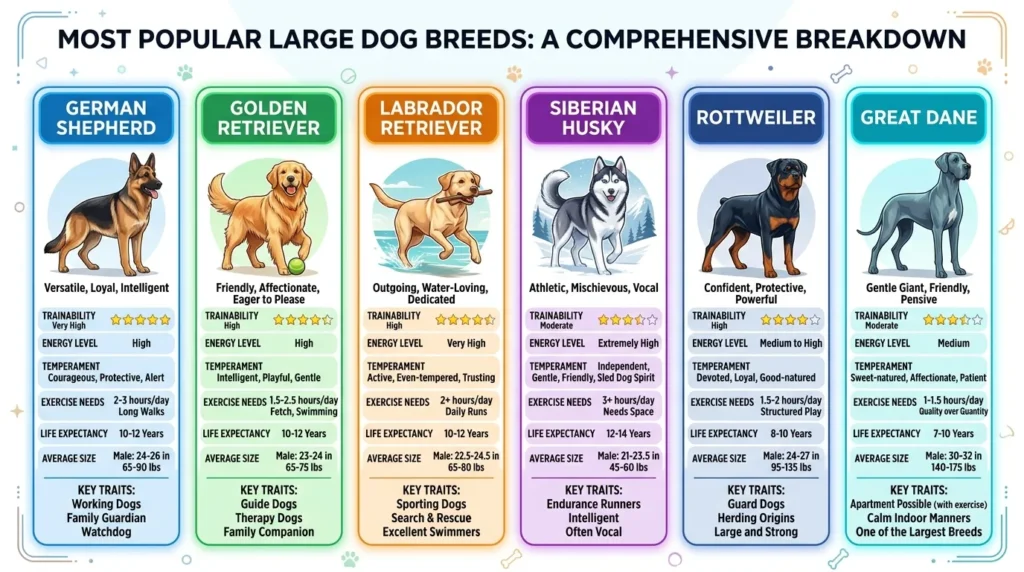
The Top Large Breeds and What Makes Them Special
Let’s look at the most beloved large dog breeds available today. Each one brings something unique so there’s genuinely something for every lifestyle.
1. German Shepherd
The German Shepherd is one of the world’s most versatile large dog breeds. Police departments, military units, and search-and-rescue teams rely on them because of their extraordinary intelligence and trainability.
- Weight: 50–90 pounds
- Temperament: Loyal, courageous, intelligent
- Energy level: High
- Best for: Active families, experienced owners
2. Labrador Retriever
Labrador Retrievers have held the title of America’s most popular dog breed for decades and it’s easy to see why. They’re friendly, gentle, and endlessly enthusiastic about life.
- Weight: 55–80 pounds
- Temperament: Friendly, outgoing, gentle
- Energy level: High
- Best for: Families with children, first-time owners
3. Golden Retriever
Golden Retrievers are the ultimate family dog. They’re patient, affectionate, and genuinely joyful companions. Also, they’re incredibly gentle with children and get along beautifully with other pets.
- Weight: 55–75 pounds
- Temperament: Gentle, trustworthy, friendly
- Energy level: Moderate-High
- Best for: Families, therapy dog work
4. Rottweiler
Rottweilers have a tough reputation but experienced owners know they’re deeply loving and loyal family dogs. However, they do need consistent training and an experienced handler from a young age.
- Weight: 80–135 pounds
- Temperament: Confident, calm, protective
- Energy level: Moderate
- Best for: Experienced owners, active households
5. Boxer
Boxers are playful, energetic, and absolutely devoted to their families. Because of their patient nature with children, they’re one of the most popular large breeds for family households worldwide.
- Weight: 50–80 pounds
- Temperament: Fun-loving, bright, loyal
- Energy level: High
- Best for: Active families with children
Pro Tip: If you’re choosing between large dog breeds and you have young children, always visit the specific dog, not just the breed before committing. Individual temperament varies even within breeds. Meeting the dog in person tells you far more than any breed description ever could.
More Beloved Large Dog Breeds Worth Knowing
6. Siberian Husky
Siberian Huskies are breathtakingly beautiful and full of personality. They’re friendly and gentle but also independent and vocal. Therefore, they suit active owners who enjoy outdoor adventures.
- Weight: 35–60 pounds
- Temperament: Outgoing, mischievous, loyal
- Energy level: Very High
- Best for: Active owners, cold climates
7. Doberman Pinscher
Dobermans are elegant, athletic, and remarkably loyal. Also, they’re among the most intelligent large dog breeds which makes them highly trainable but also demanding of mental stimulation.
- Weight: 60–100 pounds
- Temperament: Alert, loyal, fearless
- Energy level: High
- Best for: Experienced owners, active lifestyles
8. Bernese Mountain Dog
Bernese Mountain Dogs are gentle giants in the truest sense. They’re calm, patient, and absolutely wonderful with children. However, their thick double coat requires regular grooming and they don’t tolerate heat well.
- Weight: 70–115 pounds
- Temperament: Gentle, calm, affectionate
- Energy level: Moderate
- Best for: Families, cooler climates
9. Great Dane
Great Danes are the tallest dog breed in the world yet somehow also one of the gentlest. They’re nicknamed “gentle giants” because of their calm, loving nature despite their enormous size.
- Weight: 110–175 pounds
- Temperament: Friendly, patient, dependable
- Energy level: Moderate
- Best for: Spacious homes, families
10. Irish Setter
Irish Setters are strikingly beautiful large dogs with rich mahogany coats and boundless energy. They’re affectionate, playful, and form incredibly strong bonds with their families.
- Weight: 60–70 pounds
- Temperament: Playful, energetic, friendly
- Energy level: Very High
- Best for: Active families, outdoor enthusiasts
[Tiny Dog Breeds That Stay Small: 12 Best Picks for 2026]
Large Dog Breeds Side-by-Side: Quick Comparison Table
Finding Your Perfect Match at a Glance
| Breed | Weight | Energy | Kid-Friendly | Grooming | Experience Needed |
| German Shepherd | 50–90 lbs | High | ⭐⭐⭐⭐ | Medium | Moderate |
| Labrador Retriever | 55–80 lbs | High | ⭐⭐⭐⭐⭐ | Low | Beginner |
| Golden Retriever | 55–75 lbs | Mod-High | ⭐⭐⭐⭐⭐ | Medium | Beginner |
| Rottweiler | 80–135 lbs | Moderate | ⭐⭐⭐⭐ | Low | Experienced |
| Boxer | 50–80 lbs | High | ⭐⭐⭐⭐⭐ | Low | Moderate |
| Siberian Husky | 35–60 lbs | Very High | ⭐⭐⭐⭐ | High | Experienced |
| Doberman | 60–100 lbs | High | ⭐⭐⭐⭐ | Low | Experienced |
| Bernese Mountain | 70–115 lbs | Moderate | ⭐⭐⭐⭐⭐ | High | Moderate |
| Great Dane | 110–175 lbs | Moderate | ⭐⭐⭐⭐⭐ | Low | Moderate |
| Irish Setter | 60–70 lbs | Very High | ⭐⭐⭐⭐ | Medium | Moderate |
How to Use This Table
First, identify your energy level honestly. Then match it to the breed’s energy rating. For example, a highly active family suits a German Shepherd or Irish Setter perfectly. However, a calmer household will find a Bernese Mountain Dog or Great Dane a much better fit.
How to Care for Large Dog Breeds: Step-by-Step Guide
What Large Breeds Need Every Day
Caring for large dog breeds requires consistent commitment across several areas. Therefore, use this step-by-step framework to set your new large dog up for success:
- Feed high-quality large breed food. Large dogs need food specifically formulated for their size. Therefore, choose a formula with controlled calcium and phosphorus levels to support healthy joint and bone development. Always consult your vet about the right daily portion for your dog’s specific weight and activity level.
- Exercise daily without exception. Most large breeds need at least 60 minutes of physical activity every day. Also, mental stimulation through training, puzzle toys, and interactive play is equally important for preventing destructive behavior.
- Train consistently from day one. A 90-pound dog that jumps on guests or pulls on the leash creates real problems. Therefore, enroll in obedience classes from puppyhood and practice commands every single day. Large breeds respond extremely well to positive reinforcement training.
- Schedule regular vet check-ups. Large breeds face specific health risks including hip dysplasia, elbow dysplasia, and bloat. Therefore, schedule bi-annual vet visits rather than just annual ones. Early detection of joint issues saves significant pain and treatment costs later.
- Groom appropriately for the breed. Some large breeds like Labrador Retrievers need minimal grooming. Others like the Bernese Mountain Dog require daily brushing to prevent painful matting. Therefore, research your specific breed’s grooming needs before bringing them home.
- Provide enough space. Large dogs need room to move. Also, they need a comfortable resting area that fits their full body. Invest in a properly sized dog bed from day one joint health in large breeds improves significantly with proper orthopedic support.
- Socialize early and continuously. Large dogs that aren’t properly socialized can become fearful or reactive which creates real safety concerns given their size. Therefore, expose your dog to different people, animals, and environments from puppyhood onward.
Common Mistakes to Avoid With Large Dog Breeds

Mistake 1: Underestimating the Cost
Large dog breeds cost significantly more to own than small breeds. Food bills are higher. Vet bills are higher. Grooming costs are higher. Also, equipment like crates, beds, and leashes costs more in larger sizes. Therefore, budget honestly before committing to a large breed monthly costs can range from $150 to $400 or more depending on the breed and your location.
Mistake 2: Skipping Obedience Training
Some owners assume large breeds are naturally well-behaved. However, no dog regardless of size develops good manners without consistent training. An untrained large dog is genuinely difficult to manage safely. Therefore, treat training as non-negotiable from the very first day your dog comes home.
Mistake 3: Ignoring Joint Health From Puppyhood
Large breed puppies grow extremely quickly. As a result, their joints are vulnerable during development. Feeding inappropriate food, allowing excessive exercise on hard surfaces, or letting puppies jump repeatedly can cause lasting joint damage. Therefore, always feed large breed puppy food specifically formulated for controlled growth, and consult your vet about appropriate exercise limits during the first year.
Mistake 4: Choosing a High-Energy Breed for a Sedentary Lifestyle
A Siberian Husky or Irish Setter in an apartment with a sedentary owner is a recipe for chaos. These dogs need significant daily exercise. Therefore, be brutally honest about your activity level before choosing a breed. A calmer large breed like the Bernese Mountain Dog or Basset Hound suits a less active household far better.
Mistake 5: Not Researching Breed-Specific Health Issues
Every large breed has specific health vulnerabilities. German Shepherds are prone to hip dysplasia. Great Danes face a higher risk of bloating, a life-threatening condition. Dobermans can develop dilated cardiomyopathy. Therefore, research your chosen breed’s common health concerns thoroughly, and discuss preventive strategies with your vet before bringing your dog home.
Pro Tip: For large breeds prone to bloat like Great Danes, Dobermans, and Weimaraners never exercise your dog within an hour of feeding. Also, use a slow-feeder bowl to reduce the speed of eating. These two simple habits significantly reduce bloat risk and could genuinely save your dog’s life.
Frequently Asked Questions About Large Dog Breeds

1. What are the most family-friendly large dog breeds?
The Golden Retriever, Labrador Retriever, Bernese Mountain Dog, Boxer, and Great Dane consistently rank as the most family-friendly large dog breeds. All five combine gentle temperaments with genuine patience around children. However, every dog needs proper training and socialization regardless of breed reputation. Also, always supervise interactions between any dog and very young children size alone doesn’t determine safety.
2. Are large dog breeds harder to train than small breeds?
Actually, many large breeds are easier to train than small ones. German Shepherds, Labrador Retrievers, Golden Retrievers, and Dobermans are all ranked among the most trainable dogs in the world. However, large breeds do require more consistent training because the consequences of bad behavior are more significant at their size. Therefore, start training from day one and never skip sessions because your dog seems “naturally well-behaved.”
3. How much exercise do large dog breeds need daily?
Most large dog breeds need between 60 and 90 minutes of exercise daily. However, this varies significantly by breed. A Labrador Retriever thrives on 90 minutes of vigorous activity. A Bernese Mountain Dog does well with 60 minutes of moderate exercise. In addition, mental stimulation through training and puzzle toys counts as part of daily exercise for large, intelligent breeds. Always research your specific breed’s needs and consult your vet about appropriate exercise levels.
4. What should I feed large dog breeds?
Large dog breeds need food specifically formulated for their size particularly during puppyhood. Look for formulas with controlled calcium and phosphorus levels to support healthy skeletal development. Also, glucosamine and chondroitin in the formula support long-term joint health. As a result, brands like Purina Pro Plan Large Breed, Hill’s Science Diet Large Breed, and Royal Canin Large Adult are frequently recommended by veterinarians. Always consult your vet about the right daily portion for your dog’s weight and activity level.
5. Do large dog breeds live shorter lives than small breeds?
Unfortunately, yes large dog breeds generally have shorter lifespans than smaller breeds. Most large breeds live between 8 and 12 years. Giant breeds like Great Danes may live only 7 to 10 years. However, excellent nutrition, regular veterinary care, appropriate exercise, and a loving environment all contribute to maximizing your large dog’s lifespan and quality of life. Therefore, preventive care is especially important for large breeds. Don’t skip those annual vet visits.
6. Are large dog breeds suitable for apartment living?
Some large dog breeds adapt surprisingly well to apartment living, particularly calmer breeds like the Greyhound, Great Dane, and Basset Hound. However, high-energy breeds like the Siberian Husky or Irish Setter genuinely need more space and outdoor access. Therefore, if you live in an apartment, choose a calmer large breed and commit to at least two substantial daily walks. Also, access to a nearby park for off-leash exercise makes apartment life much more manageable for large dogs.
7. What’s the biggest large dog breed in the world?
The Great Dane holds the record as the tallest dog breed in the world. However, the English Mastiff is often considered the heaviest, with males regularly exceeding 200 pounds. The Saint Bernard and Newfoundland also rank among the world’s largest breeds by weight. These giant breeds are gentle, calm, and loving but they require significant space, food budgets, and veterinary resources. Therefore, research giant breed care requirements thoroughly before committing to one of these magnificent animals.
Your Perfect Large Dog Is Waiting
Large dog breeds offer something truly extraordinary: a bond that feels deeper, a presence that fills a home, and a loyalty that never wavers. Whether you choose the playful Boxer, the gentle Golden Retriever, or the majestic Great Dane, a large breed dog becomes far more than a pet. They become family.
However, the key is choosing the right large breed for your specific lifestyle, space, and experience level. Therefore, use this guide as your starting point. Research thoroughly, visit breeds in person, and consult your vet before making your final decision.