

Introduction
Have you ever walked through a park and spotted five completely different dogs and wondered what breed each one was? You’re definitely not alone. With hundreds of breeds around the world, choosing the right one can feel overwhelming. That’s exactly why understanding the 100 types of dogs is so genuinely helpful.
Whether you’re a first-time dog owner or a lifelong dog lover, knowing your breeds makes a real difference. Different dogs have different energy levels, temperaments, and care needs. So finding the right match for your lifestyle is everything.
In this guide, you’ll discover 100 dog types organized by group, size, and personality. You’ll also get practical tips for choosing the right breed and avoiding common mistakes. Let’s jump right in.
100 Types of Dogs Organized by Breed Group
Why Breed Groups Matter
Dogs aren’t just categorized by size or looks. The American Kennel Club (AKC) organizes breeds into seven official groups based on their original purpose. [Cite: AKC official breed groups akc.org]
Understanding these groups helps you predict your dog’s behavior, exercise needs, and personality. Let’s explore each group and the breeds within them.
🐕 Group 1 Sporting Dogs (Active and Energetic)
Sporting dogs were originally bred to assist hunters. As a result, they’re naturally energetic, friendly, and easy to train. They love outdoor activities and need daily exercise.
Popular Sporting Dog Breeds:
- Labrador Retriever
- Golden Retriever
- Cocker Spaniel
- English Springer Spaniel
- Vizsla
- Weimaraner
- Irish Setter
- Pointer
- Brittany Spaniel
- German Shorthaired Pointer
- Chesapeake Bay Retriever
- Flat-Coated Retriever
- Nova Scotia Duck Tolling Retriever
- Sussex Spaniel
Best for: Active families, runners, and outdoor enthusiasts.
Pro Tip: If you love hiking or swimming, a Labrador or Golden Retriever will be your absolute best adventure partner.
🐕 Group 2 Hound Dogs (Independent and Loyal)
Hound dogs were bred for tracking and hunting. Therefore, they have an incredibly strong sense of smell or impressive speed sometimes both.
Popular Hound Dog Breeds:
- Beagle
- Bloodhound
- Greyhound
- Basset Hound
- Dachshund
- Whippet
- Afghan Hound
- Irish Wolfhound
- Rhodesian Ridgeback
- Saluki
- Plott Hound
- Coonhound
- Norwegian Elkhound
- Borzoi
Best for: Experienced owners who enjoy patient, independent dogs.
🐕 Group 3 Working Dogs (Strong and Protective)
Working dogs are powerful, intelligent, and loyal. They were historically bred for guarding, pulling sleds, and water rescue. However, they also make devoted family companions when properly trained.
Popular Working Dog Breeds:
- German Shepherd
- Rottweiler
- Doberman Pinscher
- Siberian Husky
- Alaskan Malamute
- Great Dane
- Boxer
- Bernese Mountain Dog
- Saint Bernard
- Mastiff
- Cane Corso
- Boerboel
- Anatolian Shepherd
- Giant Schnauzer
Best for: Experienced owners with space and time for training and exercise.
🐕 Group 4 Terrier Dogs (Feisty and Fearless)
Terriers are small but mighty. Originally bred to hunt rodents and vermin, they’re spirited, energetic, and full of personality. In addition, they tend to be stubborn so consistent training is key.
Popular Terrier Breeds:
- Bull Terrier
- Scottish Terrier
- West Highland White Terrier (Westie)
- Jack Russell Terrier
- Yorkshire Terrier
- Airedale Terrier
- Border Terrier
- Fox Terrier
- Staffordshire Bull Terrier
- American Staffordshire Terrier
- Cairn Terrier
- Bedlington Terrier
- Manchester Terrier
- Miniature Schnauzer
Best for: Confident owners who enjoy a dog with a big personality in a small body.
🐕 Group 5 Toy Dogs (Small and Affectionate)
Toy breeds are small in size but enormous in personality. They were bred specifically for companionship. As a result, they thrive on human attention and love being lap dogs.
Popular Toy Dog Breeds:
- Chihuahua
- Pomeranian
- Shih Tzu
- Maltese
- Pug
- Cavalier King Charles Spaniel
- Toy Poodle
- Havanese
- Papillon
- Italian Greyhound
- Chinese Crested
- Affenpinscher
- Brussels Griffon
- Toy Fox Terrier
Best for: Apartment dwellers, seniors, and people who want a close companion.
Pro Tip: Toy breeds are perfect for small spaces however, don’t underestimate their exercise needs. Even small dogs need daily walks and mental stimulation.
🐕 Group 6 Non-Sporting Dogs (Diverse and Unique)
This group is wonderfully diverse. Non-sporting dogs don’t fit neatly into other categories. Therefore, this group includes some of the most unique and interesting breeds in the world.
Popular Non-Sporting Breeds:
- Bulldog
- Poodle (Standard)
- Dalmatian
- Chow Chow
- Bichon Frise
- Boston Terrier
- Shiba Inu
- Lhasa Apso
- French Bulldog
- Keeshond
- Finnish Spitz
- Tibetan Spaniel
- American Eskimo Dog
- Schipperke
Best for: All types of owners because this group is incredibly varied in temperament and size.
🐕 Group 7 Herding Dogs (Smart and Driven)
Herding dogs are among the most intelligent breeds on earth. They were bred to control and move livestock. As a result, they’re highly focused, responsive, and need lots of mental stimulation.
Popular Herding Dog Breeds:
- Border Collie
- Australian Shepherd
- Shetland Sheepdog (Sheltie)
- Welsh Corgi (Pembroke)
- Welsh Corgi (Cardigan)
- Belgian Malinois
- Australian Cattle Dog
- Old English Sheepdog
- Collie (Rough)
- Bouvier des Flandres
- Bearded Collie
- Entlebucher Mountain Dog
- Swedish Vallhund
- Canaan Dog
Best for: Active families, farms, and owners who enjoy training and dog sports.
🐕 Bonus Breeds Rare and Rising Stars
Finally, here are two increasingly popular breeds rounding out our list of 100 types of dogs:
- Lagotto Romagnolo a curly-coated Italian breed originally trained for truffle hunting
- Xoloitzcuintli (Mexican Hairless Dog) one of the oldest and rarest dog breeds in the world
[8 Of the Best Cars Dogs and the Features That Make Them Pup-Friendly]
How to Choose the Right Dog Breed for Your Lifestyle
Step-by-Step Breed Selection Guide
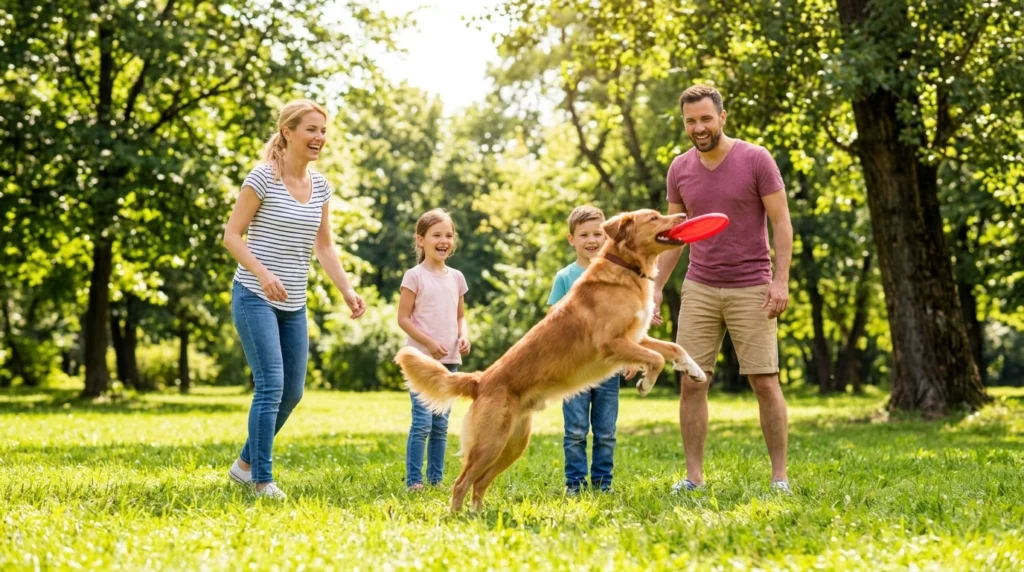
Choosing from 100 types of dogs can feel overwhelming. However, following a simple process makes the decision much easier and more enjoyable.
- First, assess your living space. Large working dogs like Great Danes need room to move. Toy breeds like Chihuahuas are perfect for apartments.
- Next, consider your activity level honestly. Border Collies and Huskies need hours of exercise daily. Bulldogs and Basset Hounds prefer a relaxed pace.
- Then, think about your experience level. First-time owners do well with Labrador Retrievers or Golden Retrievers. Experienced owners can handle strong-willed breeds like Rottweilers.
- Also, factor in allergies. Poodles, Bichon Frises, and Portuguese Water Dogs shed minimally. Therefore, they’re excellent choices for allergy sufferers.
- Consider your family situation. Some breeds are naturally gentle with children. For example, Golden Retrievers, Beagles, and Cavalier King Charles Spaniels are famous for their patience with kids.
- Research grooming requirements. Long-coated breeds like Shih Tzus need regular grooming appointments. Short-coated breeds like Boxers are much lower maintenance.
- Finally, visit a reputable breeder or rescue. Meeting dogs in person tells you more than any website ever could. Trust your instincts when you meet a dog face-to-face.
Comparing Popular Types of Dogs by Size and Temperament
Quick Comparison Table
| Breed | Size | Energy Level | Good With Kids | Grooming Needs |
| Golden Retriever | Large | High | ⭐⭐⭐⭐⭐ | Moderate |
| French Bulldog | Small | Low-Medium | ⭐⭐⭐⭐ | Low |
| Border Collie | Medium | Very High | ⭐⭐⭐ | Moderate |
| Chihuahua | Tiny | Medium | ⭐⭐ | Low |
| German Shepherd | Large | High | ⭐⭐⭐⭐ | Moderate-High |
| Poodle (Standard) | Medium-Large | High | ⭐⭐⭐⭐⭐ | High |
| Beagle | Medium | Medium-High | ⭐⭐⭐⭐⭐ | Low |
| Rottweiler | Large | Medium-High | ⭐⭐⭐ | Low |
| Shih Tzu | Small | Low | ⭐⭐⭐⭐ | High |
| Siberian Husky | Medium-Large | Very High | ⭐⭐⭐⭐ | Moderate |
What This Table Tells You
Every dog is different even within the same breed. However, this table gives you a solid starting point. Use it alongside personal research and, if possible, spending time with the breed before committing.
Common Mistakes When Choosing Between Types of Dogs
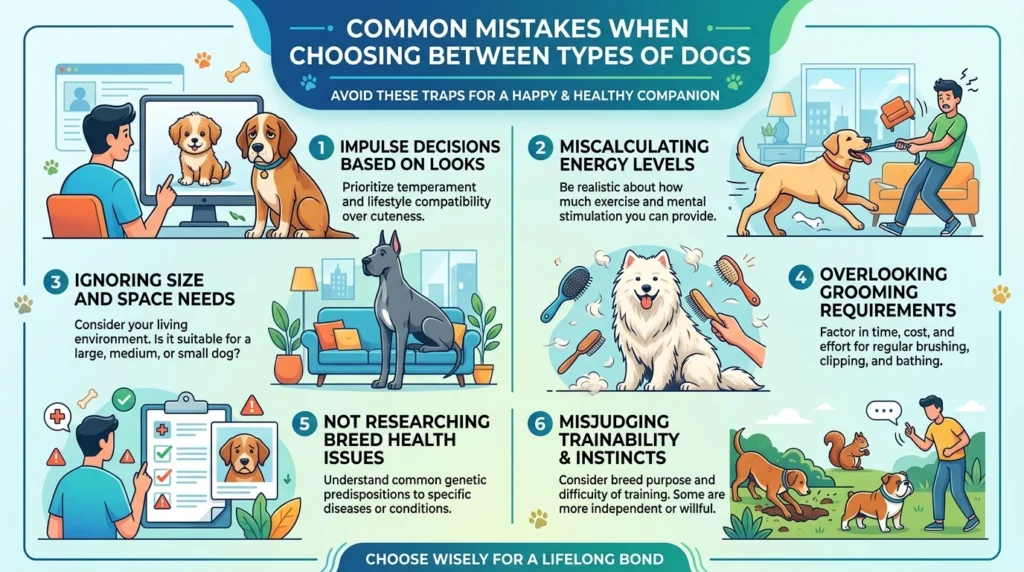
Mistake 1 Choosing Based on Looks Alone
A dog might look adorable in photos. However, their energy level, temperament, and needs might not match your lifestyle at all. For example, Siberian Huskies look beautiful but need two or more hours of vigorous exercise daily.
Mistake 2 Underestimating Exercise Needs
Many owners adopt active breeds like Border Collies or Australian Shepherds without realizing the commitment involved. These dogs need mental and physical stimulation every single day. Without it, they become destructive and anxious.
Mistake 3 Ignoring Grooming Costs
Long-coated breeds like Afghan Hounds or Shih Tzus require professional grooming every 6 to 8 weeks. Therefore, grooming costs add up quickly over a dog’s lifetime. Always factor this into your budget before choosing a breed.
Mistake 4 Skipping Health Research
Different breeds carry different genetic health risks. For instance, large breeds like Great Danes are prone to bloat. Brachycephalic breeds like Bulldogs and Pugs often have breathing issues. Always consult your vet and research breed-specific health concerns before making a decision.
Mistake 5 Overlooking Rescue and Adoption
Many people assume they must buy from a breeder to get a specific breed. Actually, breed-specific rescue organizations exist for almost every breed imaginable. Adopting a dog saves a life and often costs significantly less than purchasing from a breeder.
Pro Tip: Before choosing any dog, spend time volunteering at a local shelter. You’ll quickly learn which energy levels and temperaments feel like the right fit for your home.
Frequently Asked Questions About 100 Types of Dogs
1. What are the most popular types of dogs in the world?
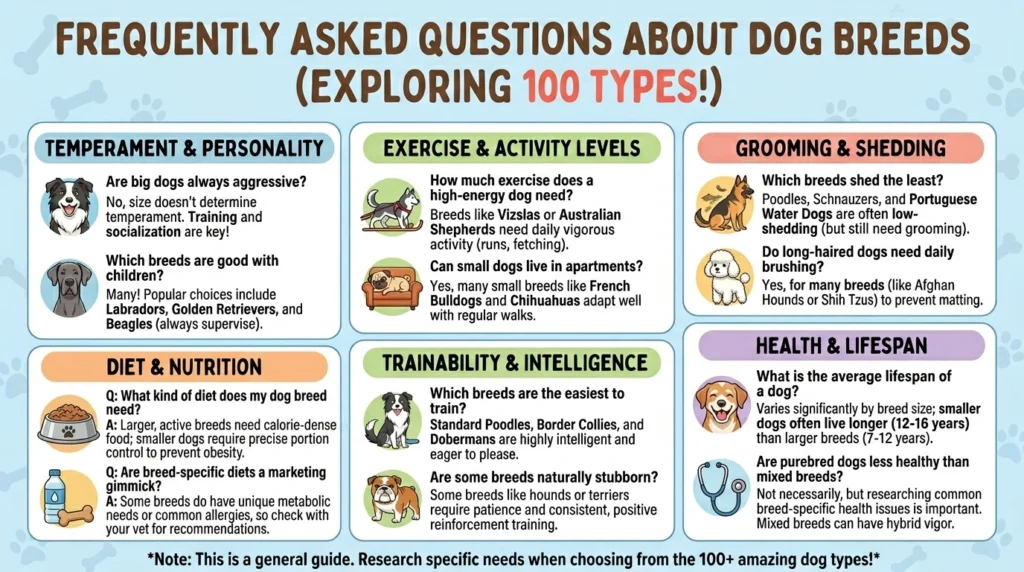
The Labrador Retriever has consistently held the top spot as the world’s most popular dog breed for decades. Golden Retrievers, French Bulldogs, German Shepherds, and Poodles also rank among the most popular globally. Their popularity comes from their adaptability, friendly temperaments, and suitability for families of all sizes.
2. Which types of dogs are best for first-time owners?
First-time owners do best with breeds that are naturally friendly, trainable, and adaptable. Labrador Retrievers, Golden Retrievers, Cavalier King Charles Spaniels, Pugs, and Bichon Frises are all excellent choices. These breeds are forgiving of beginner mistakes and respond well to positive reinforcement training.
3. Are there types of dogs that don’t shed much?
Yes several breeds are considered low-shedding or hypoallergenic. Poodles, Bichon Frises, Portuguese Water Dogs, Maltese, and Schnauzers shed very minimally. However, no dog breed is completely allergen-free. Always spend time with a breed before adopting if allergies are a concern for your family.
4. What types of dogs live the longest?
Smaller breeds generally live longer than larger breeds. Chihuahuas, Dachshunds, Toy Poodles, and Shih Tzus commonly live 14 to 18 years with proper care. In contrast, giant breeds like Great Danes and Irish Wolfhounds typically live only 7 to 10 years. Regular vet checkups, proper nutrition, and daily exercise all support a longer, healthier life.
5. Which types of dogs are best for apartment living?
Many breeds thrive in apartments, size isn’t the only factor. French Bulldogs, Cavalier King Charles Spaniels, Shih Tzus, Pugs, and Greyhounds (yes, really!) all adapt well to apartment life. The key factor is daily walks and mental stimulation, not floor space alone. Greyhounds, for example, are surprisingly calm indoors despite their speed outdoors.
6. How do I know which of the 100 types of dogs suits me?
Start by honestly assessing your lifestyle. Consider your activity level, living space, experience with dogs, budget for grooming and vet care, and whether children or other pets are in your home. Then research breeds that match those factors. Finally, visiting breeders or rescues in person, meeting a dog face-to-face is the most reliable way to know if they’re a good match for you.
7. Are mixed-breed dogs better than purebreds?
Neither is objectively better, both have genuine advantages. Mixed breeds often benefit from “hybrid vigor,” meaning fewer genetic health problems. Purebred dogs offer more predictable temperament and appearance. The best dog is simply the one that fits your lifestyle, whether purebred or mixed. Always consider adoption from a rescue before purchasing from a breeder.
Conclusion
Exploring 100 types of dogs is genuinely one of the most exciting journeys any dog lover can take. From tiny Chihuahuas to giant Saint Bernards, from energetic Border Collies to laid-back Basset Hounds there’s a perfect dog for every lifestyle and personality.
The key is doing your research, being honest about your lifestyle, and choosing a breed whose needs you can genuinely meet. Remember, a dog is a 10 to 15 year commitment so taking time to choose wisely is one of the most loving things you can do.