Introduction
At first glance, you might think you’re looking at a raccoon. However, look closer and you’ll realize this creature is something entirely different. The raccoon dog is one of the most unique and misunderstood animals on the planet.
Despite its name, the raccoon dog isn’t related to raccoons at all. It’s actually a member of the dog family Canidae making it a distant cousin of foxes and wolves. Yet its striking facial markings look almost identical to a North American raccoon. That’s where the name comes from.
Native to East Asia, the raccoon dog has fascinated wildlife enthusiasts, scientists, and animal lovers for centuries. Also, it’s recently gained global attention due to its role in wildlife trade and disease research.
In this complete guide, you’ll discover everything worth knowing from where raccoon dogs live and what they eat, to whether they make good pets and why conservation efforts matter. Let’s explore this remarkable animal together.
What Is a Raccoon Dog? Everything You Need to Know
The Basics Species and Classification
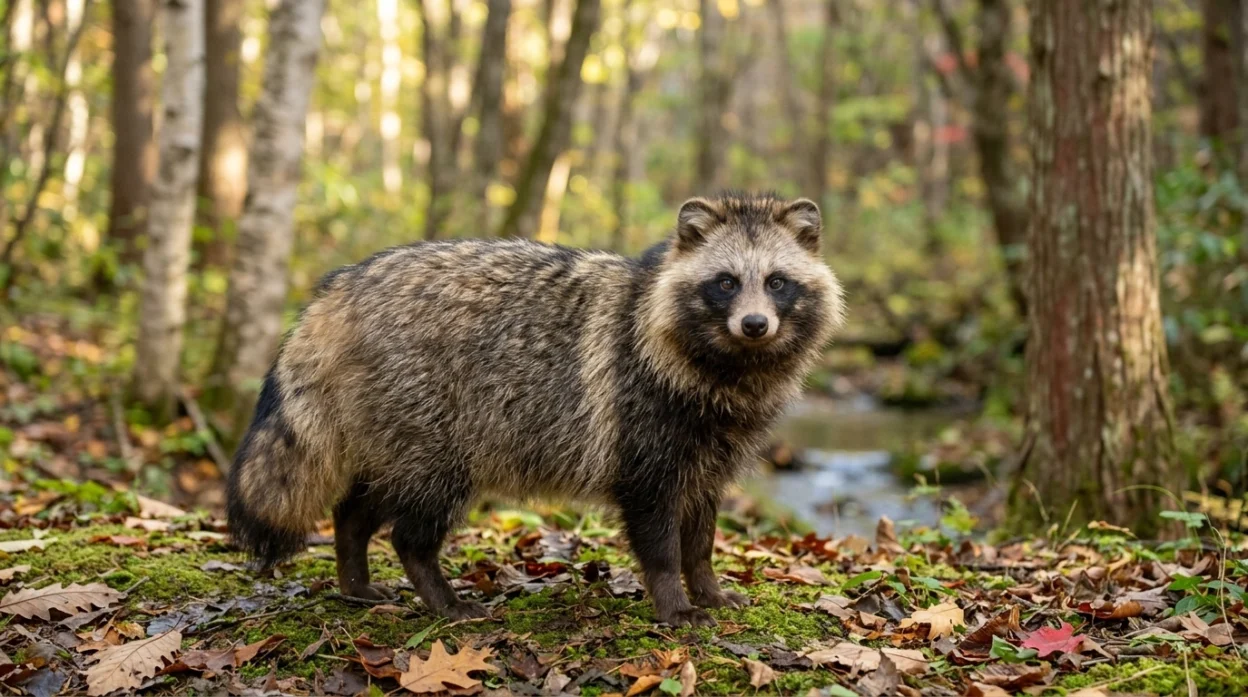
The raccoon dog (Nyctereutes procyonoides) belongs to the family Canidae. Therefore, it shares its family with domestic dogs, wolves, and foxes but it looks remarkably like a raccoon. This visual similarity to raccoons comes from the dark facial mask markings around its eyes.
Here are the key classification facts:
- Scientific name: Nyctereutes procyonoides
- Family: Canidae (dog family)
- Order: Carnivora
- Native range: East Asia China, Japan, Korea, Russia
- Introduced range: Parts of Europe, including Finland, Germany, and France
- Conservation status: Least Concern (IUCN)
Physical Appearance
Raccoon dogs are stocky, medium-sized animals. An adult typically weighs between 4 and 10 kilograms (9 to 22 pounds). Their body length ranges from 50 to 68 centimeters, with a relatively short, fluffy tail.
Their most distinctive features include:
- Dark facial mask similar to a raccoon’s markings
- Thick, fluffy coat ranges from yellowish-brown to dark grey
- Short legs giving them a low, waddle-like walk
- Round face with small ears and dark eyes
- Seasonal weight changes they gain significant weight before winter
Also, the raccoon dog is the only canid species known to hibernate during winter, a truly remarkable adaptation that sets it apart from all other members of the dog family.
Raccoon Dog Habitat, Range, and Behavior
Where Does the Raccoon Dog Live?
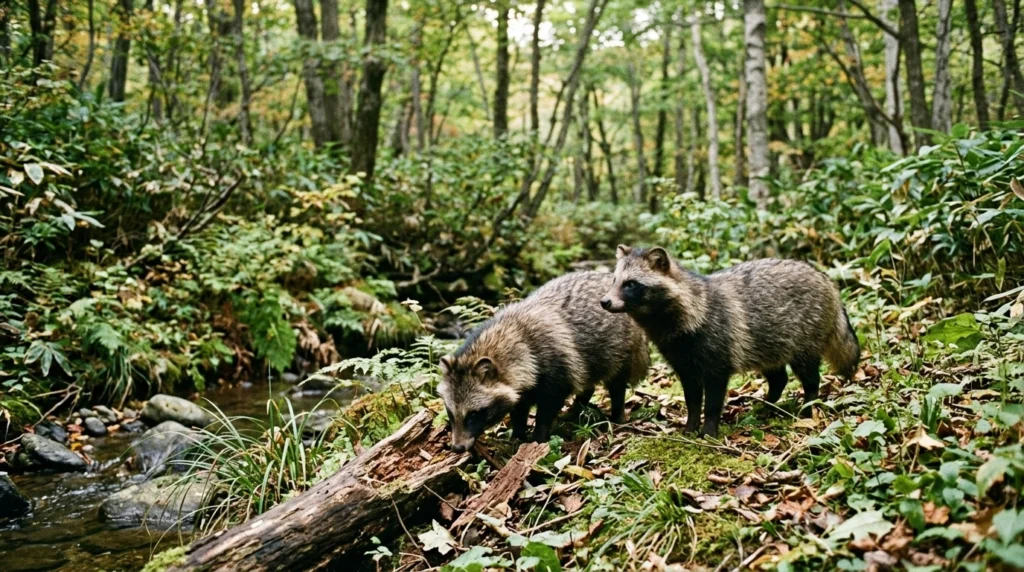
The raccoon dog originally comes from East Asia. However, it now lives across a surprisingly wide range due to both natural expansion and human introduction.
Native habitat regions:
- Eastern China
- Japan (known locally as tanuki)
- Korean Peninsula
- Far eastern Russia
- Parts of Vietnam and northeastern India
Introduced European populations:
In the 20th century, the Soviet Union intentionally released raccoon dogs in European Russia for the fur trade. As a result, populations spread rapidly westward. Today, raccoon dogs live wild across Finland, Sweden, Germany, Poland, France, and other European countries. Because of this spread, they’re now considered an invasive species in much of Europe.
Daily Behavior and Activity Patterns
Raccoon dogs are primarily nocturnal animals. They become most active at dusk and through the night. However, they’re also known to forage during daytime hours in quieter, undisturbed areas.
Key behavioral traits include:
- Omnivorous diet they eat almost anything available
- Monogamous pairs raccoon dogs typically mate for life
- Cooperative parenting both parents raise pups together
- Hibernation the only canid to enter a true winter sleep
- Excellent swimmers they cross rivers and streams easily
- Burrowing they use dens abandoned by foxes and badgers
The Hibernation Phenomenon
Ever wondered why raccoon dog hibernation is so remarkable? Unlike true hibernators, raccoon dogs enter a state called torpor a lighter sleep where body temperature drops moderately. Therefore, they can wake during mild winter periods to forage before returning to their den.
To prepare for winter torpor, raccoon dogs eat heavily during autumn. As a result, they can double their summer body weight. This fat reserve fuels them through months of reduced or no activity, a survival strategy that’s genuinely impressive for a member of the dog family.
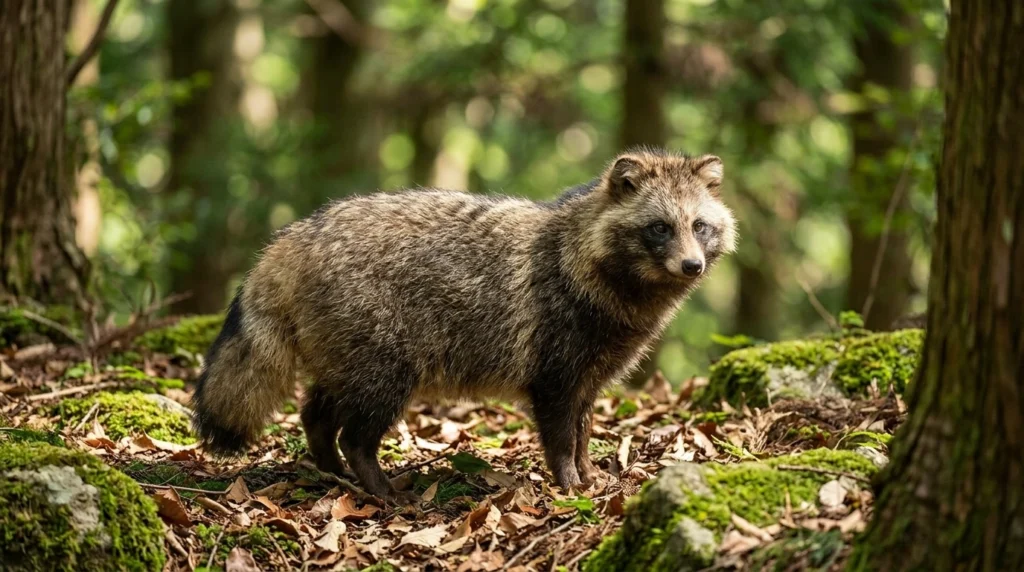
Pro Tip: If you’re a wildlife photographer hoping to spot raccoon dogs, autumn is your best season. They’re most visible at dawn and dusk during their pre-winter feeding frenzy, active, confident, and surprisingly approachable in undisturbed woodland settings.
Raccoon Dog Diet: What Do They Actually Eat?
A Truly Opportunistic Omnivore
The raccoon dog eats almost everything it can find. Therefore, it thrives in diverse environments from dense forests to farmland edges, riverbanks, and wetlands.
Seasonal Diet Breakdown
| Season | Primary Food Sources |
| Spring | Frogs, insects, small mammals, bird eggs |
| Summer | Berries, fruits, fish, invertebrates, small birds |
| Autumn | Berries, nuts, acorns, fungi, carrion |
| Winter (if active) | Carrion, roots, stored body fat |
How They Hunt and Forage
Raccoon dogs use their sensitive noses to locate food. They dig through leaf litter, explore riverbanks, and wade through shallow water searching for prey. Also, they readily scavenge carrion making them effective clean-up animals in their ecosystems.
Because of their flexible diet, raccoon dogs adapt quickly to new environments. This adaptability is one reason introduced European populations spread so successfully across the continent.
Raccoon Dog vs. Raccoon: Key Differences Explained
Why People Confuse These Two Animals
The visual similarity between raccoon dogs and raccoons is striking. However, these two animals are not related at all. One belongs to the dog family. The other belongs to the raccoon family (Procyonidae) native to the Americas.
Side-by-Side Comparison
| Feature | Raccoon Dog | Raccoon |
| Family | Canidae (dogs) | Procyonidae (raccoons) |
| Origin | East Asia | North America |
| Tail | Short, fluffy, plain | Ringed, bushy |
| Feet | Dog-like paws | Hand-like, dexterous |
| Diet | Omnivore | Omnivore |
| Hibernation | Yes (torpor) | No |
| Social structure | Monogamous pairs | Solitary |
| Size | 4–10 kg | 3.5–9 kg |
The Key Visual Differences
First, look at the tail. A raccoon has a distinctive ringed, bushy tail. A raccoon dog has a short, plain fluffy tail with no rings. Also, raccoons have highly dexterous, hand-like front feet. Raccoon dogs have standard dog-like paws. Therefore, once you know what to look for, telling them apart is actually straightforward.
Important Facts and Conservation of the Raccoon Dog
Conservation Status in Native Range
In their native East Asian range, raccoon dogs face several pressures. However, their populations remain relatively stable overall. The IUCN currently lists them as Least Concern globally.
Threats They Face
Despite a stable overall status, raccoon dogs encounter real threats:
- Fur trade they’re farmed extensively in China for fur
- Habitat loss deforestation reduces available territory in native range
- Road traffic a significant mortality cause in European populations
- Disease risk they can carry rabies and other zoonotic diseases
- Hunting pressure in some regions, they’re hunted as pests
The COVID-19 Connection
Raccoon dogs gained significant global media attention in 2023. Researchers found genetic evidence linking raccoon dogs sold at the Huanan Seafood Market in Wuhan, China, to early COVID-19 samples. Therefore, scientists continue to study the potential role of wildlife markets in disease transmission. This research doesn’t definitively prove raccoon dogs caused the pandemic however, it highlights the importance of wildlife trade regulation.
Are Raccoon Dogs Invasive in Europe?
Yes in Europe, raccoon dogs are classified as an invasive alien species under EU regulations. Because introduced populations spread rapidly, they now compete with native wildlife and can carry diseases like rabies and Echinococcus tapeworm. Therefore, many European countries actively manage their populations through hunting and trapping programs.
Common Mistakes and Misconceptions About the Raccoon Dog
This is the most common misunderstanding. Raccoon dogs and raccoons share similar facial markings but they’re not related. Raccoon dogs belong to the dog family. Raccoons belong to a completely separate family found only in the Americas. Therefore, their similarity is a case of convergent evolution between two unrelated animals developing similar traits independently.
Misconception 2: They Make Good Pets
Some people attempt to keep raccoon dogs as exotic pets. However, this is generally a poor idea for several important reasons:
- They have strong wild instincts that don’t adapt well to captivity
- Their nocturnal behavior makes them disruptive household animals
- Keeping them is illegal in many countries including much of the EU
- They can carry zoonotic diseases transmissible to humans
- Their welfare suffers significantly in domestic environments
Always consult local wildlife laws before considering any exotic animal as a pet.
Misconception 3: They’re Dangerous to Humans
Raccoon dogs are naturally shy and avoid humans whenever possible. Therefore, they pose very little direct threat to people. However, they can carry rabies in some regions. As a result, you should never handle a wild raccoon dog and always consult a doctor immediately if bitten or scratched by any wild animal.
Misconception 4: European Raccoon Dogs Are Native Wildlife
Many European residents assume raccoon dogs have always lived in their forests. However, they’re actually a 20th-century introduction. Because they spread so rapidly and impact native species, wildlife authorities treat them as an invasive species requiring active management not protected native wildlife.
Pro Tip: If you spot a raccoon dog in Europe, report your sighting to your national wildlife authority or invasive species monitoring program. Your observation contributes to important population tracking data that helps researchers understand the species’ spread and impact.
Frequently Asked Questions About the Raccoon Dog
1. Is a raccoon dog actually a dog?
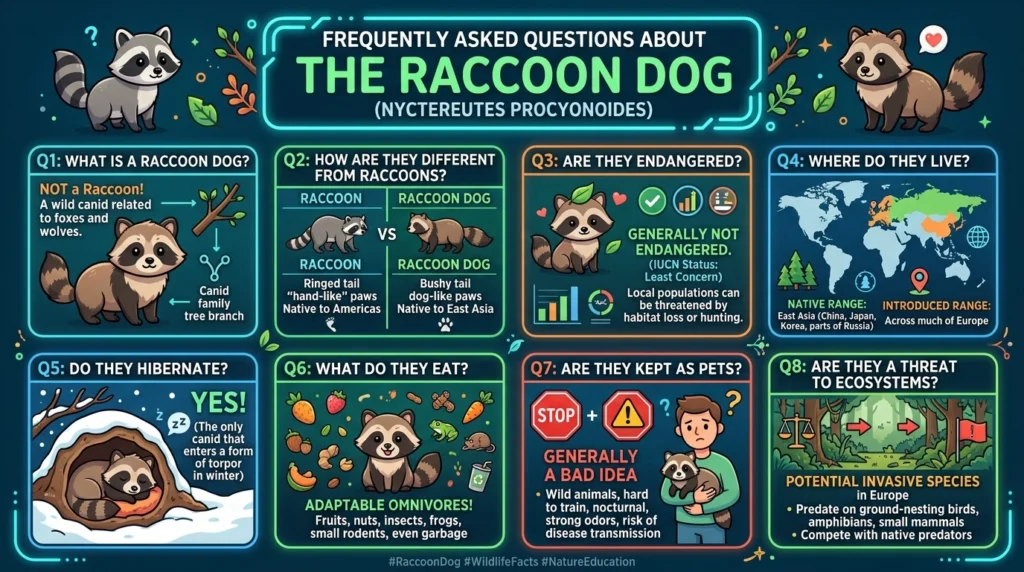
Yes, the raccoon dog is a genuine member of the dog family (Canidae). Therefore, it’s more closely related to foxes and wolves than to raccoons. Despite its name and raccoon-like appearance, it shares the evolutionary lineage of all canids. Its DNA confirms its place firmly within the dog family tree, making it a fascinating example of how similar appearances can evolve in completely unrelated animal groups.
2. Can you keep a raccoon dog as a pet?
Keeping a raccoon dog as a pet is illegal in many countries including all EU member states, where they’re listed as invasive alien species. Also, even where legal, raccoon dogs are difficult to keep because of their wild instincts, nocturnal habits, and specific dietary needs. Their welfare suffers in domestic settings. Therefore, wildlife experts universally advise against keeping them as pets. If you’re interested in a unique dog-like companion, consider adopting from a shelter instead you’ll find equally fascinating personalities without the ethical and legal complications.
3. Do raccoon dogs really hibernate?
Yes raccoon dogs are the only canid species known to hibernate. However, their winter sleep is technically called torpor rather than true hibernation. During torpor, their body temperature drops and metabolism slows significantly but not as deeply as a bear or hedgehog. They can wake during mild winter periods to forage briefly before returning to their den. This remarkable adaptation helps them survive harsh winters in their native East Asian and introduced European ranges.
4. Where do raccoon dogs live in the wild?
Raccoon dogs live naturally in East Asia particularly China, Japan, Korea, and eastern Russia. However, introduced populations now exist across much of Europe following deliberate releases during the Soviet era for fur farming purposes. As a result, they currently inhabit forests, wetlands, farmland edges, and riverbanks from Finland to France. They thrive in diverse habitats because of their flexible omnivorous diet and strong adaptability.
5. What do raccoon dogs eat?
Raccoon dogs eat an extremely varied diet which is a key reason they adapt so successfully to different environments. Their diet includes frogs, fish, insects, small mammals, birds and their eggs, berries, fruits, nuts, fungi, and carrion. Also, they readily eat agricultural crops and human food waste near settlements. Because of this flexibility, they thrive in both wilderness areas and farmland edges, making them genuinely opportunistic omnivores in the truest sense.
6. Are raccoon dogs dangerous to native wildlife?
In their native East Asian range, raccoon dogs form part of balanced ecosystems. However, in Europe where they’re an invasive species they impact native wildlife significantly. They compete with red foxes and badgers for den sites and food. Also, they prey on ground-nesting birds and amphibians, reducing populations of vulnerable native species. Therefore, European wildlife authorities classify them as ecologically harmful and implement management programs to control their spread.
7. What is the connection between raccoon dogs and COVID-19?
In 2023, international researchers published an analysis suggesting that raccoon dog DNA was found alongside early COVID-19 genetic material from the Huanan Seafood Market in Wuhan, China. This finding raised the possibility that raccoon dogs sold at wildlife markets could have been intermediate hosts in the virus’s transmission to humans. However, this evidence doesn’t definitively confirm raccoon dogs caused the pandemic. Ongoing scientific research continues to investigate the origins of COVID-19 through multiple lines of evidence.
The Raccoon Dog Deserves Your Attention
The raccoon dog is genuinely one of the most fascinating animals you’ll ever learn about. It looks like a raccoon, belongs to the dog family, hibernates like a bear, and has now spread across two continents. Few animals combine such extraordinary traits in one compact, fluffy package.
Understanding the raccoon dog matters both for wildlife conservation and for public health awareness. Therefore, sharing accurate information about this remarkable species helps combat misinformation and supports better wildlife policy.
Whether you first encountered the raccoon dog through a nature documentary, a news story, or simple curiosity you now know the full picture. Also, that knowledge makes you a more informed wildlife advocate.