

Introduction
Your dog eats every single day. That means the kibble sitting in that bag on your kitchen floor is probably the single most repeated health decision you make for your pet and yet most of us choose it based on what’s familiar, what’s on sale, or what looks good on the bag.
Finding the best dry dog food isn’t complicated once you know what to look for. But without that knowledge? The pet food aisle is genuinely overwhelming. Dozens of brands, hundreds of formulas, and every single one of them claiming to be the healthiest, most natural, most complete option on the shelf.
I’ve spent years digging into pet nutrition research, reading ingredient labels, following vet recommendations, and watching real dogs thrive or struggle on different foods. And I can tell you with confidence: there are genuinely great kibbles out there at every price point. You just need to know how to find them.
This guide cuts through the noise. You’ll get my honest top picks, a clear breakdown of what separates good dry food from great, and everything you need to walk into any pet store and choose with total confidence. Let’s go.
What Makes the Best Dry Dog Food Actually Good?
Before we get to specific brand recommendations, let’s talk about what quality actually looks like in a bag of kibble. Because “best” means something different depending on who’s marketing it versus what nutritional science actually supports.
Ingredient Quality Starts at the Top
The ingredient list on any dry dog food is ordered by weight before processing which means whatever’s listed first is present in the highest amount. The best dry dog food always leads with a named animal protein: chicken, beef, salmon, turkey, or lamb.
When you see corn, wheat, or soy listed as the first or second ingredient, the food is more filler than nutrition. That doesn’t mean grains are always bad but they shouldn’t be carrying the formula.
The AAFCO Statement Matters More Than You Think
Every quality dry dog food carries an AAFCO nutritional adequacy statement on the label. This confirms the food meets minimum standards for complete and balanced nutrition. But here’s the detail most people miss, look for whether it says “formulated to meet” standards or “complete and balanced based on feeding trials.”
Feeding trial substantiation means the food was actually tested on real dogs over time. That’s a stronger validation than simply formulating a nutrient profile on paper.
Protein, Fat, and Fiber The Numbers That Matter
On the guaranteed analysis panel, here’s what to look for in a solid dry dog food:
- Protein: At least 18–25% for healthy adult dogs; 22–32% for puppies
- Fat: 8–15% for most adult dogs; slightly higher for active or working dogs
- Fiber: 3–5% is typical; higher fiber can help with weight management
- Moisture: Usually around 10% in dry food much lower than wet food’s 75–85%
These ranges aren’t absolute; your vet can give you specific targets based on your dog’s breed, size, and health status.
Red Flags to Avoid on Any Label
- BHA, BHT, or ethoxyquin synthetic preservatives with questionable long-term safety profiles
- Artificial colors (Red 40, Yellow 5, Blue 2) zero nutritional value, purely cosmetic
- “Meat by-product meal” without a named species vague and unaccountable
- Multiple corn derivatives listed separately a classic ingredient-splitting trick to hide how much corn is actually in the formula
- No AAFCO statement walk away immediately
How to Choose the Best Dry Dog Food for Your Dog: Step-by-Step

Every dog is different, which means the “best” kibble for a 10-pound senior Chihuahua is very different from the best for a 90-pound active German Shepherd. Here’s how to narrow it down for your specific situation:
- Identify your dog’s life stage first. Puppy, adult, or senior, this is your starting point and it’s non-negotiable. Puppy formulas have more calories, DHA, and specific calcium ratios for growing bones. Senior formulas are typically lower in calories with added joint support. Never skip this step.
- Consider your dog’s size and breed. Large breed puppies in particular need carefully controlled calcium and phosphorus levels to prevent developmental bone problems. Many premium brands offer size-specific formulas they’re worth using, not just clever marketing.
- Think about any specific health concerns. Sensitive stomach? Skin allergies? Excess weight? Low energy? All of these point toward different formula choices. Brands like Purina Pro Plan and Hill’s Science Diet have specialized lines for each of these conditions and your vet can help you match the right one.
- Set a realistic budget then find the best within it. The best dry dog food isn’t always the most expensive. There are genuinely excellent options at mid-range price points. What matters is getting the best ingredient quality and nutritional profile you can afford consistently because changing foods constantly disrupts your dog’s digestion.
- Research recall history. Before committing to any brand, spend two minutes Googling their recall history. One isolated recall doesn’t doom a brand, but a pattern of contamination issues is a serious red flag. The FDA’s pet food recall database is your most reliable source.
- Check for feeding trial data. Look for that AAFCO feeding trial statement on the bag. It’s a small detail that signals a brand actually tested their food on dogs, not just formulated it to look good on paper.
- Plan a proper transition. Once you’ve chosen your food, transition gradually over 7–10 days. Mix 25% new food with 75% old to start, then slowly shift the ratio. Rushing this causes digestive upset and it can make you wrongly conclude the new food doesn’t agree with your dog.
Pro Tip: When you find a dry dog food that works well for your dog, good stool consistency, shiny coat, healthy weight, good energy stick with it. Variety might be appealing to us humans, but dogs thrive on dietary consistency. Don’t fix what isn’t broken.
[Dental Dog Food: The Complete Guide to Healthier Teeth and Gums for Dogs 1]
Best Dry Dog Food in 2026: Honest Brand-by-Brand Breakdown
Here’s where we get specific. These are the brands and formulas that consistently earn top marks from veterinary nutritionists, independent reviewers, and real dog owners across different budgets and needs.
– $
| Brand & Formula | Price Range | Best For | First Ingredient | Grain-Free? |
| Purina Pro Plan Adult (Chicken & Rice) | $$$ | Most healthy adult dogs | Chicken | No |
| Hill’s Science Diet Adult | $$$ | Vet-recommended everyday nutrition | Chicken meal | No |
| Royal Canin Breed Specific | $$$ | Breed-specific nutritional needs | Chicken by-product meal | No |
| Purina ONE Adult (Chicken & Rice) | $$ | Budget-quality balance | Chicken | No |
| Blue Buffalo Life Protection | Natural ingredient focus | Deboned chicken | Yes (some) | |
| Merrick Grain Free | $$$ | High protein, sensitive dogs | Deboned beef/chicken | Yes |
| Orijen Original | $$$$ | Premium biologically appropriate | Free-run chicken | Yes |
| Iams Adult | $$ | Active healthy adults | Chicken | No |
| Rachel Ray Nutrish | $$ | Natural diet, budget-friendly | Chicken | Yes (some) |
| Purina Dog Chow | $ | Tight budget, healthy adult dogs | Whole grain corn | No |
My Definitive Top Picks by Category
🏆 Best Overall Dry Dog Food: Purina Pro Plan Adult (Chicken & Rice)
If I had to pick one kibble for the widest range of healthy adult dogs, this is it. Real chicken is the first ingredient, it’s backed by more nutritional research than almost any other commercial brand, it has an outstanding safety record, and vets recommend it more consistently than nearly anything else on the market. It’s available in a huge range of specialized formulas for sensitive skin, weight management, sport, large breed making it genuinely adaptable to different dogs’ needs.
💰 Best Budget Dry Dog Food: Purina ONE Adult
Real chicken or beef first, no corn or wheat, solid protein and fat percentages, and a price point that makes quality nutrition accessible. Purina ONE is the food I’d recommend to someone who wants meaningfully better nutrition than standard budget brands but can’t stretch to Pro Plan pricing. It’s a genuine step up not just a marketing claim.
🐶 Best for Puppies: Purina Pro Plan Puppy (Chicken & Rice)
DHA from omega-rich fish oil for brain and vision development, optimized calcium-to-phosphorus ratios for healthy bone growth, and the same research-backed quality as the adult line. For large breed puppies specifically, look for Purina Pro Plan Large Breed Puppy the calcium levels are specifically controlled for bigger dogs.
🐕 Best for Sensitive Stomachs: Hill’s Science Diet Sensitive Stomach & Skin
Easily digestible ingredients, prebiotic fiber for gut health, and formulated specifically for dogs with digestive sensitivity. I’ve recommended this one to friends whose dogs had chronic loose stools on other foods. The improvement within a few weeks is often remarkable. Always check with your vet if your dog has ongoing digestive issues.
🏅 Best Premium Dry Dog Food: Orijen Original
If budget genuinely isn’t a concern, Orijen delivers ingredient quality that’s hard to match. About 85% of ingredients come from quality animal sources: free-run poultry, wild-caught fish, cage-free eggs. It’s a biologically appropriate formula that takes the protein-first approach as far as commercially possible. The price tag is real, but so is the quality.
👴 Best for Senior Dogs: Purina Pro Plan Bright Mind (7+)
This formula contains enhanced botanical oils shown to promote alertness and mental sharpness in dogs aged seven and older. Lower in calories than adult formulas, with added joint support. It’s one of the few senior dog foods with genuine clinical research behind the age-related cognitive support claims.
Common Mistakes People Make When Buying the Best Dry Dog Food
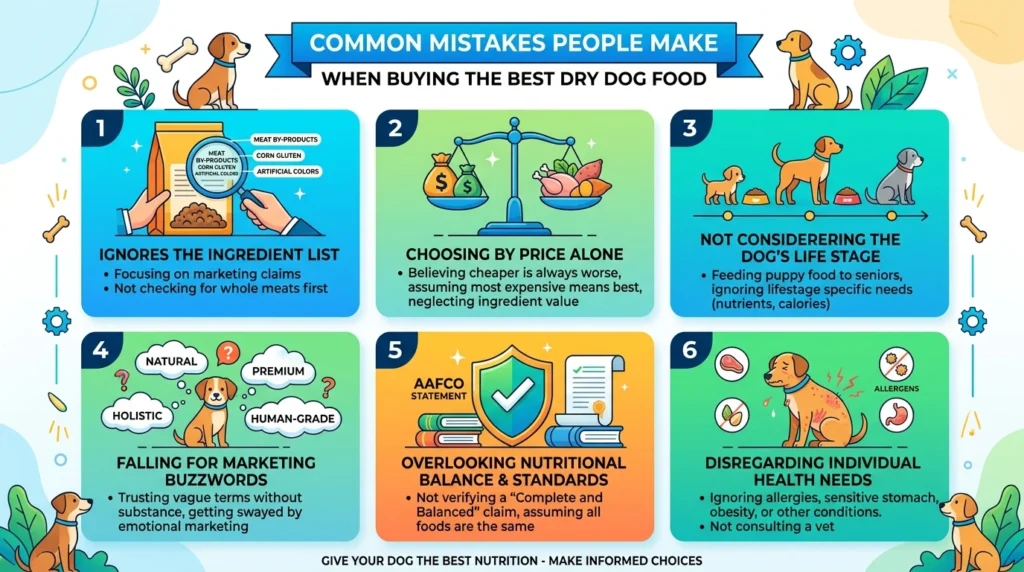
Even well-intentioned dog owners make these errors and they’re worth knowing about:
Falling for the Grain-Free Marketing Trap
Grain-free dry dog food has been heavily marketed as the premium, healthier option. But the science doesn’t back that up for most dogs. Since 2018, the FDA has been investigating a potential connection between grain-free diets (especially those high in peas, lentils, and legumes) and dilated cardiomyopathy (DCM) , a life-threatening heart condition.
Unless your vet has specifically recommended grain-free for a diagnosed grain allergy or sensitivity, there’s no proven health advantage to avoiding grains. Many dogs do perfectly well and some do better on grain-inclusive formulas.
Choosing Based on the Front of the Bag
“Natural.” “Premium.” “Wholesome.” “Veterinarian Recommended.” These terms on the front of a dog food bag are largely unregulated and tell you almost nothing about actual nutritional quality. The real information is on the back of the ingredient list, guaranteed analysis, and AAFCO statement. Train yourself to flip the bag immediately.
Not Accounting for Caloric Density
A premium dry dog food is often more calorie-dense and more digestible than a budget option meaning your dog needs less of it per meal to meet their nutritional needs. If you switch to a higher-quality food without adjusting portions, your dog will gain weight. Always follow the feeding guidelines and adjust based on your dog’s actual body condition.
Rotating Proteins Unnecessarily
You may have heard that rotating proteins keeps your dog from developing food allergies. This isn’t well-supported by veterinary science, and constantly switching proteins can actually make it harder to identify a real food allergy if one develops because you’ve never established a clear baseline. Find a protein your dog does well on and stick with it unless there’s a medical reason to change.
Skipping the Vet Conversation
If your dog has any ongoing health issues, digestive problems, skin conditions, weight struggles, joint issues, low energy the food conversation should involve your vet. The best dry dog food for a dog with kidney disease is completely different from the best for a healthy athletic dog. Your vet’s input is irreplaceable.
Pro Tip: A simple way to assess whether your dog’s current dry food is working: check the “three S’s” every few weeks Stool (firm, well-formed, not excessive), Shine (coat should be glossy, not dull or flaky), and Spring (good energy and enthusiasm for play). If all three are positive, you’ve found a winner.
Frequently Asked Questions About the Best Dry Dog Food
1. What is the single best dry dog food recommended by vets?
There’s no universal single answer: different dogs have different needs. That said, Purina Pro Plan and Hill’s Science Diet are the two brands most consistently recommended by veterinarians in the United States. Both are backed by extensive nutritional research, manufactured to high quality control standards, and available in specialized formulas for different health conditions. Purina Pro Plan is particularly well-regarded for its wide range, research depth, and excellent ingredient quality. Always confirm with your own vet what’s best for your specific dog.
2. Is expensive dry dog food always better than cheap options?
Not always but there’s often a meaningful quality difference as you move up price tiers. Budget brands frequently use lower-quality protein sources, more corn and soy filler, and synthetic additives to keep costs down. Mid-range and premium brands tend to use named protein sources, better-quality carbohydrates, and more targeted nutritional profiles. That said, Purina ONE at a mid-range price delivers genuinely solid nutrition; you don’t have to spend top dollar to feed your dog well. Focus on ingredient quality over price tag.
3. How do I know if dry dog food is working for my dog?
Give any new food at least 8–12 weeks before evaluating that’s enough time for your dog’s system to fully adjust. Positive signs include firm, well-formed stools (not excessive in volume), a shiny and healthy coat, stable or appropriate weight, good energy levels, and enthusiasm at mealtimes. Negative signs to watch for include chronic loose stools, excessive gas, dull coat, flaky skin, weight gain or loss, or low energy. If you see persistent negatives, consult your vet before switching foods again.
4. Can I mix two different dry dog foods together?
You can, but there’s rarely a nutritional reason to do so if each food is already complete and balanced. Mixing can make it harder to identify the cause if your dog develops a food sensitivity or digestive issue. The one scenario where mixing makes sense is during a transition period gradually swapping old food for new over 7–10 days. Some owners also mix a small amount of a premium food into a budget brand to stretch their dollar while improving quality. If you do this, just make sure both foods are appropriate for your dog’s life stage.
5. How often should I change my dog’s dry food?
Ideally, not often. Dogs thrive on dietary consistency; their gut microbiome adapts to a specific food over time, and frequent changes disrupt that stability. The main legitimate reasons to change dry dog food are: transitioning between life stages (puppy to adult, adult to senior), a health condition requiring a therapeutic diet, a confirmed food allergy requiring a protein switch, or a brand recall. If your dog is doing well on their current food, there’s no need to change it regularly. Annual vet check-ins are a good time to reassess.
6. Is dry dog food alone enough, or do I need to add supplements?
A complete and balanced dry dog food that meets AAFCO standards should provide all the essential nutrients your dog needs, no supplements required for healthy dogs. In fact, adding supplements without veterinary guidance can actually create nutritional imbalances. The exception is dogs with specific medical conditions where a vet recommends supplementation (like omega-3s for skin conditions, or joint supplements for orthopedic issues). If you’re feeding a homemade diet, supplementation is usually necessary but that’s a conversation for your vet and a veterinary nutritionist.
7. What’s the best dry dog food for dogs with allergies?
True food allergies in dogs most commonly involve proteins: beef, chicken, dairy, and wheat are the most frequent culprits, not grains in general. The gold standard for identifying a food allergy is a veterinary-supervised elimination diet using a hydrolyzed protein or novel protein food. Once the allergen is identified, you can choose a dry food that avoids it. Hill’s Science Diet Sensitive Stomach & Skin, Purina Pro Plan Sensitive Skin & Stomach (Salmon & Rice), and Royal Canin Hydrolyzed Protein are all well-regarded options. Please consult your vet before self-diagnosing food allergies. The symptoms overlap with many other conditions.
Conclusion : Feed Your Dog the Best They Deserve Nothing Less
Finding the best dry dog food for your dog is one of the most meaningful investments you can make in their long-term health and happiness. And the good news is it’s genuinely achievable at almost any budget.
Lead with the ingredient list. Look for a named protein first. Check the AAFCO statement. Choose the right life stage formula. Research recall history. And when in doubt, talk to your vet because they know your individual dog in a way that no article or label can fully account for.
Brands like Purina Pro Plan, Hill’s Science Diet, and Purina ONE consistently deliver quality you can trust. Start there, pick the formula that fits your dog’s specific needs, and give it a proper 8–12 week trial before evaluating