

Introduction
A dog bite happens in seconds but the physical, emotional, and financial aftermath can last months or years. If you or someone you love has been bitten by a dog, you’re probably dealing with medical bills, pain, missed work, and a lot of unanswered questions about what happens next.
One of the most important questions is this: do you need a dog bite lawyer? For many victims, the honest answer is yes and sooner than most people realize.
Many injury victims don’t understand that dog bite claims involve specific laws that vary significantly by state, insurance negotiations that can be genuinely complex, and evidence that disappears quickly if not preserved immediately. A qualified dog bite lawyer helps you navigate all of these challenges and typically works on a contingency basis, meaning you pay nothing unless you win.
This guide covers everything you need to know when to hire a dog bite lawyer, what your claim may be worth, how to find the right attorney, and the most common mistakes that reduce or destroy valid claims. Let’s make sure you understand your rights.
Quick Answer
A dog bite lawyer is a personal injury attorney specializing in dog attack cases. They help victims pursue compensation for medical bills, lost wages, pain and suffering, and other damages. Most dog bite lawyers work on contingency no fee unless you win. Consult one immediately after seeking medical treatment following any serious dog bite.
Key Takeaways
- Dog bite lawyers typically work on contingency you pay nothing unless they win your case
- Most states have strict liability laws dog owners are liable even if the dog never bit anyone before
- Statute of limitations applies most states give you 2–3 years to file a claim; don’t wait
- Medical treatment first always seek medical care before anything else after a dog bite
- Dog bite claims can cover medical bills, lost wages, pain and suffering, and scarring
- Homeowners insurance covers most dog bite claims a lawyer helps maximize your recovery
When Do You Need a Dog Bite Lawyer?
You need a dog bite lawyer whenever a dog attack results in injuries requiring medical treatment, significant pain, missed work, psychological trauma, or permanent scarring. An attorney protects your rights and handles negotiations with insurance companies on your behalf.
Situations That Always Warrant Legal Help
Not every dog bite requires a lawyer, a minor nip that breaks no skin is very different from a serious attack. However, certain situations strongly call for professional legal representation:
- Injuries requiring medical treatment stitches, surgery, antibiotics, or hospitalization
- Significant scarring or disfigurement particularly on the face, hands, or visible areas
- Infection requiring prolonged treatment dog bites have high infection rates
- Lost wages from missed work any time the injury affects your ability to earn income
- Psychological trauma PTSD, anxiety, and phobias following dog attacks are compensable
- Attacks on children children suffer disproportionately from bite injuries and trauma
- Insurance company contact if the dog owner’s insurer contacts you, get a lawyer first
- Disputed liability any time the dog owner denies responsibility or disputes facts
Why Early Legal Consultation Matters
Many dog bite victims wait too long before consulting a lawyer. However, evidence disappears quickly, witness memories fade, security camera footage is overwritten, and the dog owner’s insurance company begins building their defense immediately.
Therefore, consulting a dog bite lawyer within days of the attack, not weeks or months maximizes your ability to preserve critical evidence and build the strongest possible case.
What Steps Should You Take After a Dog Bite?
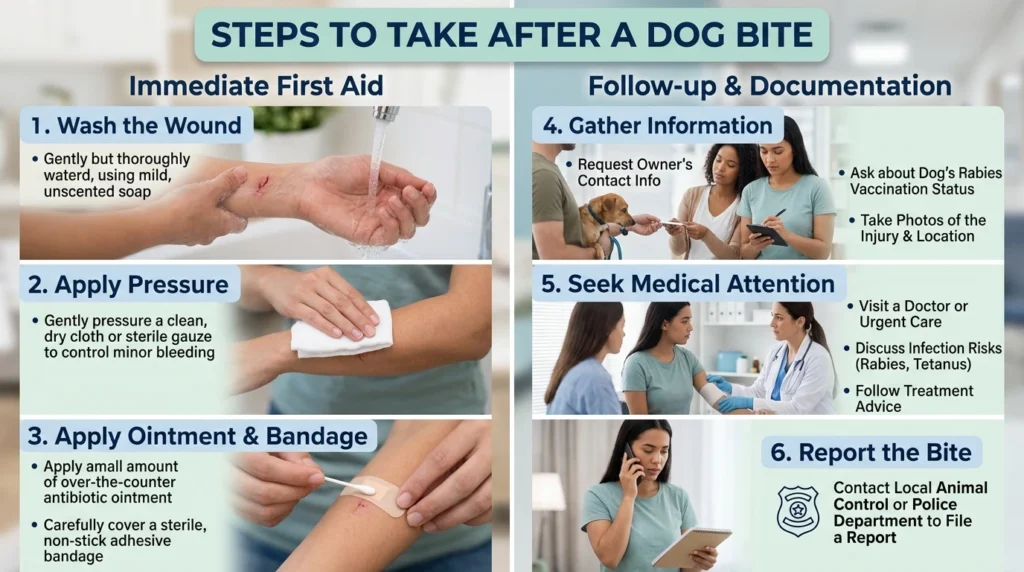
After a dog bite, your first priority is your health and safety. Next, protecting your legal rights requires specific documented actions taken as close to the incident as possible.
Step-by-Step Guide: What to Do After a Dog Bite
- Seek medical treatment immediately. Go to an emergency room, urgent care, or your doctor right away even for wounds that appear minor. Dog bites carry serious infection risk, including Pasteurella, Staphylococcus, and in rare cases, rabies. Also, medical records from the day of the attack become critical evidence in your legal claim. Therefore, never skip or delay medical treatment.
- Document your injuries with photographs. Take clear photographs of all wounds immediately and continue photographing throughout the healing process. Also, photograph the location where the attack occurred. As a result, you create a visual record of the full extent of your injuries and the context of the attack.
- Identify the dog and its owner. Get the dog owner’s name, address, and phone number. Also, ask specifically whether the dog’s rabies vaccinations are current and this information affects your medical treatment decisions. If the owner refuses information, ask witnesses to help identify them and notify animal control immediately.
- Report the bite to local animal control. File an official report with your local animal control agency or police department. This creates an official record of the attack, triggers an investigation into the dog’s history, and may reveal prior bite incidents that strengthen your liability claim.
- Collect witness information. Get names and contact information from anyone who witnessed the attack. Also, ask whether any nearby businesses might have security cameras that captured the incident. As a result, you secure evidence before it becomes unavailable.
- Preserve all documentation. Keep all medical bills, prescription receipts, treatment records, and communication from the dog owner or their insurance company. Also, keep a written journal documenting your pain levels, treatment, emotional state, and how the injury affects daily activities. This contemporaneous record becomes valuable evidence of your damages.
- Consult a dog bite lawyer before speaking to insurance companies. Dog owners’ homeowners insurance typically covers bite claims. However, insurance adjusters work for the insurer not for you. Therefore, consult a dog bite lawyer before giving any recorded statement or accepting any settlement offer. Early settlement offers are almost always significantly lower than what an attorney can negotiate.
Pro Tip: Never post about your dog bite injury on social media while your claim is active. Insurance defense attorneys routinely monitor claimants’ social media for posts, photos, or check-ins that suggest your injuries are less serious than claimed. Even an innocent post showing you smiling at an event can be used to minimize your claim. Therefore, treat all social media as potentially visible to opposing counsel throughout your case.
What Compensation Can a Dog Bite Lawyer Help You Recover?
A dog bite lawyer helps victims pursue multiple categories of compensation depending on the severity of the attack and its impact on the victim’s life.
Types of Compensation Available in Dog Bite Cases
| Compensation Category | What It Covers | Examples |
| Medical expenses | All treatment costs | ER visits, surgery, antibiotics, therapy |
| Future medical costs | Ongoing treatment needs | Plastic surgery, scar revision, counseling |
| Lost wages | Income lost during recovery | Missed work days, reduced capacity |
| Loss of earning capacity | Long-term income impact | Career limitations from permanent injury |
| Pain and suffering | Physical pain experienced | Documented through medical records and journals |
| Emotional distress | Psychological impact | PTSD, anxiety, phobias, sleep disorders |
| Scarring and disfigurement | Permanent appearance changes | Facial scars, visible permanent injuries |
| Loss of enjoyment of life | Impact on daily activities | Inability to participate in previous activities |
How Much Is a Dog Bite Case Worth?
Compensation amounts vary enormously based on injury severity, location, insurance coverage, and liability clarity. According to the Insurance Information Institute, the average dog bite claim in the United States exceeds $64,000. However, serious attacks involving significant scarring, surgery, or permanent disability often settle or verdict for significantly higher amounts.
Therefore, never accept an early settlement offer without consulting a dog bite lawyer who can assess the true value of your specific claim. Also, initial offers from insurance companies rarely reflect full compensation; they’re designed to close claims quickly and cheaply.
How to Find the Right Dog Bite Lawyer
Finding the right dog bite lawyer significantly affects your outcome. Therefore, approach this selection with the same care you’d apply to any major life decision.
What to Look for in a Dog Bite Lawyer
Experience in personal injury law: Look for attorneys who specifically handle personal injury cases ideally with documented experience in dog bite claims. Dog bite law involves specific liability statutes that vary by state. Therefore, a generalist attorney may not have the specialized knowledge needed to maximize your recovery.
Contingency fee structure: Most reputable dog bite lawyers work on contingency typically 33% of the settlement or verdict. Also, they advance all case costs with repayment from the recovery. Therefore, you pay nothing upfront and nothing if the case doesn’t result in recovery. Be cautious of any attorney requesting upfront fees for a dog bite claim.
Clear communication: Your attorney should explain your rights, the process, and realistic expectations clearly. Also, they should be accessible for questions and proactively update you on case developments. Therefore, the initial consultation interaction tells you a lot about what the ongoing relationship will look like.
Local knowledge: Dog bite laws vary significantly by state and even by municipality. Also, local courts and insurance companies have different tendencies that experienced local attorneys understand. Therefore, prioritize attorneys licensed and practicing in your specific state.
How to Evaluate Dog Bite Lawyers
| Evaluation Factor | What to Look For |
| Experience | Personal injury focus; dog bite case history |
| Fee structure | Contingency only no upfront costs |
| Communication | Responsive; clear explanations |
| Reviews | Consistent positive client feedback |
| Resources | Ability to advance costs and hire experts |
| Track record | History of successful settlements and verdicts |
| Local license | Licensed in your state; local court experience |
Common Mistakes That Damage Dog Bite Claims
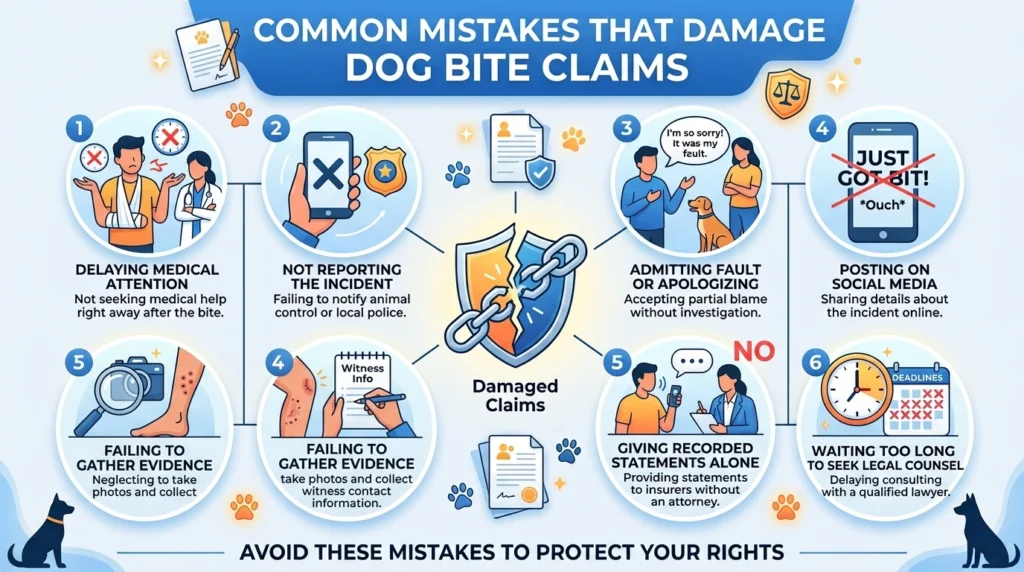
Mistake 1: Accepting the First Settlement Offer
A simple mistake I often see is victims accepting the first offer from the dog owner’s insurance company usually within days of the attack. Insurance companies make early offers specifically because they’re lower than fair value. Also, early settlement before full medical treatment concludes means you can’t include future medical costs. Therefore, never settle any dog bite claim without first consulting a dog bite lawyer who can assess full claim value.
Mistake 2: Missing the Statute of Limitations
Every state sets a deadline for the statute of limitations for filing personal injury claims. Most states allow 2–3 years from the date of the attack, but some allow less. Also, special rules sometimes apply to children, government employees, or other specific circumstances. Therefore, consulting a dog bite lawyer promptly waiting too long permanently eliminates your right to any compensation, regardless of how valid your claim is.
Mistake 3: Giving Recorded Statements to Insurance Companies
Insurance adjusters routinely contact dog bite victims quickly and ask for recorded statements. However, these statements are designed to gather information that reduces or eliminates your claim. Also, you’re likely still in pain, medically unstable, and not in a position to accurately describe the full impact of your injuries. Therefore, politely decline any recorded statement request and consult a dog bite lawyer first.
Mistake 4: Failing to Document Injuries Thoroughly
Many victims photograph their initial injuries but stop documenting as healing progresses. However, healing photographs tell an equally important story: the extended healing period, scar formation, and ongoing treatment all demonstrate continuing damages. Therefore, photograph your injuries weekly throughout the entire healing process. Also, keep detailed written records of pain levels, treatment sessions, and how injuries affect daily life.
Mistake 5: Assuming You Can’t Afford a Lawyer
Many dog bite victims don’t consult attorneys because they assume legal help is unaffordable. However, virtually all reputable dog bite lawyers work on contingency meaning no upfront cost and no fee unless they recover compensation for you. Therefore, cost is not a legitimate reason to forgo legal representation in a dog bite case. Also, studies consistently show that represented plaintiffs recover significantly more compensation even after attorney fees than unrepresented victims negotiating directly with insurers.
Frequently Asked Questions About Dog Bite Lawyers
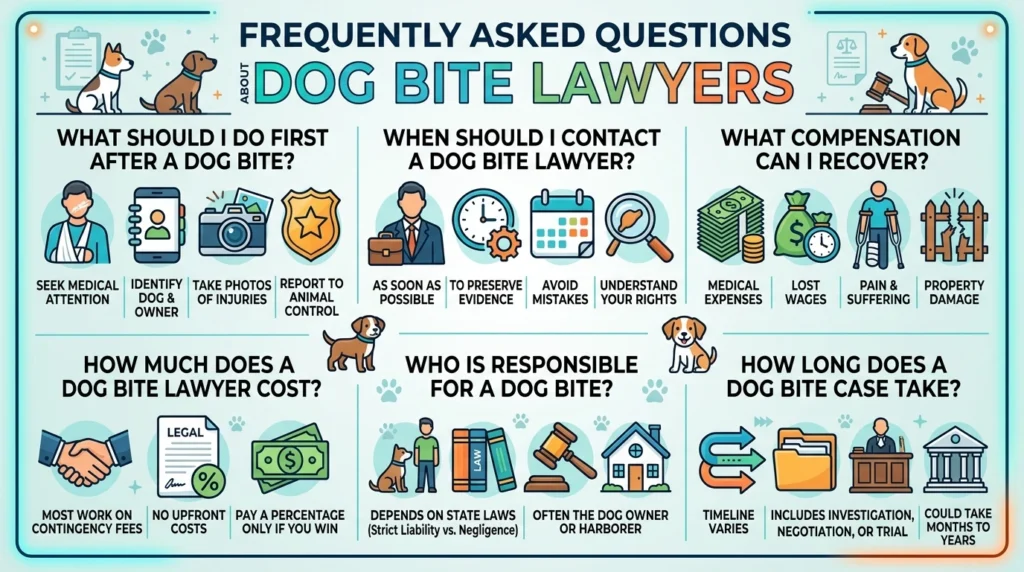
1. How much does a dog bite lawyer cost?
Most dog bite lawyers work on a contingency fee basis meaning you pay nothing upfront and no attorney fees unless they recover compensation for you. The standard contingency fee is typically 33% of the settlement amount, though this can vary by attorney and case complexity. Also, the attorney typically advances all case costs investigation, expert fees, filing fees with repayment from the final recovery. Therefore, hiring a dog bite lawyer involves no out-of-pocket risk for the client. This fee structure also incentivizes attorneys to maximize your recovery, since their fee is a percentage of what they win for you.
2. What are dog bite liability laws?
Dog bite liability laws determine who is legally responsible when a dog attacks someone. Most US states follow one of two legal frameworks. Strict liability states including California, Texas, and Florida hold dog owners liable for bites regardless of whether the dog showed previous aggression. One-bite rule states fewer in number may require proof that the owner knew the dog was dangerous. Also, some states use negligence-based standards. Therefore, the specific laws in your state significantly affect your claim’s strength and value. A dog bite lawyer licensed in your state understands exactly which laws apply to your situation.
3. What if the dog owner has no homeowners insurance?
Many dog bite claims go through the dog owner’s homeowners or renters insurance policy. However, some dog owners lack insurance coverage. In these situations, your options depend on your specific circumstances. Your own auto insurance (if the attack involved a vehicle), umbrella insurance, or health insurance may provide some coverage. Also, you may still pursue a personal lawsuit against the dog owner though collecting damages from an uninsured individual can be challenging. Therefore, a dog bite lawyer can investigate all potential compensation sources beyond the obvious ones and advise you on the most viable recovery strategy given your specific situation.
4. How long does a dog bite lawsuit take?
Dog bite cases resolve in widely varying timeframes depending on claim complexity, injury severity, liability disputes, and whether the case settles or proceeds to trial. Many dog bite claims settle within 6–18 months through insurance negotiation. However, cases involving disputed liability, serious injuries, or uncooperative insurers can take 2–4 years or longer. Also, cases that proceed to trial typically take longer than those settling before trial. Therefore, don’t expect immediate resolution and be cautious of pressure to settle quickly, as rushing typically benefits insurers rather than victims. Your dog bite lawyer will advise on realistic timelines for your specific case.
5. Can I file a dog bite claim if the attack happened on the dog owner’s property?
Yes in most cases. Many people assume that being on the dog owner’s property eliminates their right to compensation. However, most states provide legal protection to lawful visitors including invited guests, delivery drivers, mail carriers, and others with legal reason to be on the property. Also, trespassers have more limited rights, though children may receive protection in some states under the attractive nuisance doctrine. Therefore, where the attack occurred matters but being on the owner’s property doesn’t automatically prevent a valid claim. Consult a dog bite lawyer to assess your specific circumstances and applicable state law.
6. What if a child was bitten by a dog?
Dog bite cases involving children often result in significantly higher compensation than adult victim cases because children suffer disproportionate physical and psychological harm from attacks. Children’s faces are at dog-mouth level making facial bites and scarring particularly common and severe. Also, children often develop lasting psychological trauma including PTSD and dog phobias following attacks. In addition, special legal rules often apply to child victims including extended statute of limitations in many states. Therefore, if a child was bitten, consulting a dog bite lawyer is especially important. A qualified attorney ensures the child’s full damages including future impact on their life are properly valued and pursued.
7. What if I was partially at fault for the dog bite?
Many states follow comparative negligence rules meaning you can still recover compensation even if you were partially responsible for provoking or approaching the dog. Under pure comparative negligence, your compensation reduces by your percentage of fault. Under modified comparative negligence used in many states you can recover as long as you’re less than 50% or 51% at fault. Therefore, even if you believe you may have contributed to the incident, consult a dog bite lawyer before assuming you have no claim. Insurance companies often exaggerate victim fault to reduce payouts. An attorney ensures fault is allocated fairly based on the actual facts.
Protect Your Rights Don’t Wait
If you or a loved one has been attacked by a dog, a qualified dog bite lawyer is your most important ally in the aftermath. They help you navigate complex liability laws, preserve critical evidence, negotiate with insurance companies from a position of strength, and pursue full compensation for your injuries.
The contingency fee structure means there’s no financial barrier to getting professional legal help. Also, the statute of limitations means there’s no time advantage to waiting. Therefore, consult a dog bite lawyer as soon as possible after seeking medical treatment ideally within days of the attack.
The compensation you’re entitled to covers real costs, medical bills, lost income, pain, emotional trauma, and the lasting impact on your quality of life. A qualified attorney ensures you pursue all of it.