
Introduction
Bringing a new puppy home is one of life’s most joyful moments. However, figuring out what to feed them can feel genuinely stressful. Walk into any pet store and you’ll face an entire wall of options all claiming to be the best.
Here’s the truth: best dry puppy food choices matter more than most people realize. Puppies aren’t just small adult dogs. Their nutritional needs are completely different. They need specific nutrients for brain development, bone growth, and immune system support during those critical early months.
In my experience, the right puppy food sets the foundation for a healthy adult dog. Choose well now, and you’ll likely deal with fewer health problems later. Choose poorly, and nutritional gaps show up as slow growth, dull coats, or digestive issues.
This guide breaks everything down clearly. You’ll learn what nutrients matter most, which brands consistently deliver, and how to pick the perfect formula for your specific puppy. Let’s get your pup off to the best possible start.
What Makes the Best Dry Puppy Food Different From Adult Food?
Puppies Have Unique Nutritional Needs
Adult dog food simply doesn’t contain the right balance of nutrients for a growing puppy. Therefore, always choose a formula specifically labeled for puppies or “all life stages.”
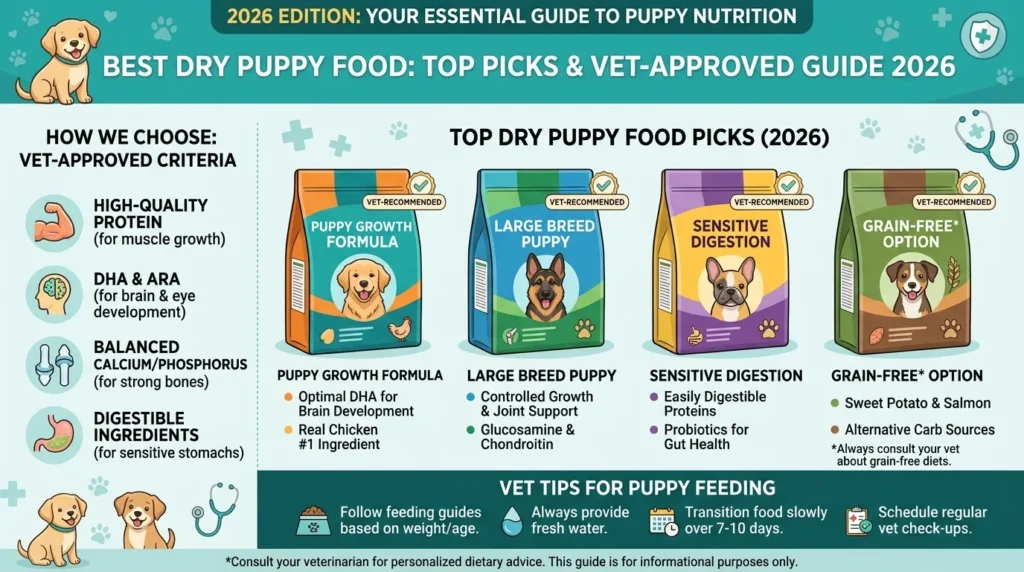
Here’s what the best dry puppy food must deliver:
- Higher protein content supports rapid muscle development and growth
- DHA (docosahexaenoic acid) an omega-3 fatty acid critical for brain and vision development
- Calcium and phosphorus essential for strong bone and teeth formation
- Higher caloric density puppies burn energy fast and need more calories per pound
- Antioxidants support the developing immune system
- Digestible carbohydrates provide steady energy throughout the day
The AAFCO Statement Why It Matters
Every quality puppy food carries an AAFCO nutritional adequacy statement. This tells you whether the food meets the minimum nutritional standards for puppy growth.
Look for one of these two statements on the label:
- “Formulated to meet AAFCO nutrient profiles for growth” meets standards on paper
- “Complete and balanced based on AAFCO feeding trials for growth” tested on real puppies
The second statement is stronger. Therefore, whenever possible, choose a brand that carries feeding trial validation not just formulation claims.
Large Breed vs. Small Breed Puppy Food
This distinction matters enormously. Large breed puppies need carefully controlled calcium and phosphorus levels during growth. Too much calcium accelerates skeletal development faster than joints can handle which leads to developmental orthopedic disease.
Therefore, always match the formula to your puppy’s expected adult size:
- Small breed puppy food higher caloric density, smaller kibble size
- Large breed puppy food controlled calcium levels, specific joint support
- All-life-stages food must meet puppy growth standards for all sizes
How to Choose the Best Dry Puppy Food: Step-by-Step Guide
Start With These Simple Steps
Choosing puppy food doesn’t need to be complicated. However, skipping key steps leads to poor choices. Therefore, follow this straightforward process:
- Determine your puppy’s expected adult size. Small (under 20 lbs), medium (20–50 lbs), or large (over 50 lbs) this decision shapes everything else. Large breed puppies need very different calcium levels than small breeds.
- Look for a named protein as the first ingredient. Chicken, turkey, beef, salmon, or lamb should appear first on the ingredient list. Avoid formulas where corn, wheat, or vague terms like “meat meal” lead the list.
- Check for DHA specifically. DHA from fish oil or fish meal supports brain and eye development during the critical first year. Therefore, confirm this nutrient appears on the label; it’s non-negotiable for growing puppies.
- Find the AAFCO growth statement. Scan the back panel for “complete and balanced for growth” or “all life stages.” A formula without this statement isn’t verified for puppy nutrition.
- Avoid artificial preservatives and colors. The best dry puppy food uses natural preservatives like mixed tocopherols (Vitamin E). Artificial additives like BHA, BHT, and ethoxyquin serve no nutritional purpose.
- Choose the appropriate kibble size. Small breed puppies struggle with large kibble. Therefore, confirm the formula uses appropriately sized pieces for your puppy’s mouth and jaw development.
- Plan a proper feeding schedule. Young puppies need three meals daily until about 6 months. Then transition to two meals per day. Also, always provide fresh water alongside dry food hydration matters especially for growing puppies.
- Consult your vet before finalizing your choice. Breed-specific health concerns, allergies, and digestive sensitivities all affect which formula suits your individual puppy best. Your vet’s input is genuinely irreplaceable here.
Pro Tip: Transition your puppy to any new food gradually over 7–10 days. Mix 25% new food with 75% current food on days 1–3. Then shift to 50/50 on days 4–6. Finally, move to 75% new food on days 7–9, and 100% on day 10. This prevents digestive upset and gives the gut time to adjust comfortably.
[Dry Dog Food Near Me: Best Places to Buy & Top Tips 2026]
Best Dry Puppy Food Brands: Honest Comparison for 2026
Top Brands Side by Side
Here’s how the most consistently recommended dry puppy food brands compare across key criteria:
| Brand & Formula | First Ingredient | DHA Source | AAFCO Validation | Large Breed Option | Price Range |
| Purina Pro Plan Puppy | Chicken | Fish oil | Feeding trials | Yes | $$$ |
| Hill’s Science Diet Puppy | Chicken meal | Fish oil | Feeding trials | Yes | $$$ |
| Royal Canin Breed Specific Puppy | Chicken by-product | Fish oil | Feeding trials | Yes | $$$ |
| Purina ONE Puppy | Chicken | Fish oil | Formulation | Yes | $$ |
| Blue Buffalo Life Protection Puppy | Deboned chicken | Fish oil | Some formulas | Yes | $$$ |
| Iams Proactive Health Puppy | Chicken | Fish oil | Formulation | Yes | $$ |
| Wellness Complete Puppy | Deboned chicken | Salmon oil | Formulation | Yes | $$$ |
| Orijen Puppy | Free-run chicken | Whole fish | Limited | Yes | $$$$ |
My Honest Top Picks
🏆 Best Overall: Purina Pro Plan Puppy
Purina Pro Plan Puppy consistently earns the top recommendation from veterinarians. Real chicken leads the formula. DHA from omega-rich fish oil supports brain and vision development. The formula carries feeding-trial-validated AAFCO compliance meaning real puppies confirmed its nutritional adequacy.
Also, the large breed puppy version uses specifically controlled calcium levels for healthy skeletal development. In addition, live probiotics in some versions support digestive health from the very start. It’s available almost everywhere and delivers exceptional value for the nutritional quality provided.
🥈 Best Vet-Recommended Alternative: Hill’s Science Diet Puppy
Hill’s Science Diet Puppy brings the same clinical rigor that makes Hill’s a vet favorite across all life stages. Chicken meal leads the formula to a concentrated protein source with solid nutritional density. DHA from fish oil supports cognitive development. Feeding trial validation confirms real-world nutritional adequacy.
The large breed version is particularly well-regarded. It supports healthy bone growth with precise calcium and phosphorus ratios, something especially critical for breeds like Labradors, German Shepherds, and Golden Retrievers.
💰 Best Value Pick: Purina ONE Puppy
For budget-conscious puppy owners who still want quality nutrition, Purina ONE Puppy delivers impressively. Real chicken leads the ingredient list. DHA from fish oil is present. Solid protein percentages support healthy muscle development throughout the growth phase.
Therefore, if Purina Pro Plan stretches your monthly budget, Purina ONE provides a meaningful step up from basic budget brands without the premium price tag.
🌿 Best Natural Option: Wellness Complete Health Puppy
Wellness uses deboned chicken first, salmon oil for omega-3s, and a thoughtful blend of fruits and vegetables. No artificial colors, flavors, or preservatives appear anywhere in the formula. It’s a genuinely clean natural option for puppy owners who prioritize whole-food ingredients.
Common Mistakes to Avoid With Best Dry Puppy Food
Mistake 1: Feeding Adult Food to a Puppy
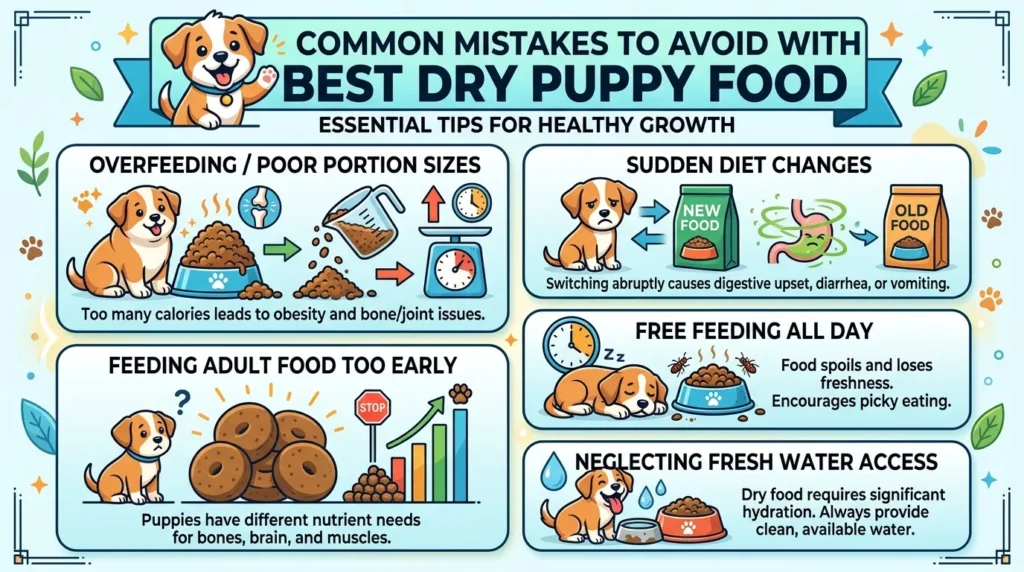
This is the most common and most consequential mistake. Adult formulas don’t contain adequate DHA, protein ratios, or calcium levels for puppy growth. As a result, puppies fed adult food long-term may show slower development, weaker bones, or compromised immune function. Therefore, always use a puppy-specific or all-life-stages formula until your puppy reaches adult weight.
Mistake 2: Choosing Large Breed Food for a Small Puppy
Large breed puppy formulas have lower caloric density and controlled calcium levels designed specifically for big dogs. Small breed puppies need more calories per pound and different nutrient ratios. Therefore, always match the formula to your puppy’s expected adult size, not their current tiny size.
Mistake 3: Overfeeding Because Puppies Are Always Hungry
Puppies eat enthusiastically but free feeding or overfeeding leads to rapid weight gain. Excess weight during puppyhood puts strain on developing joints, especially in large breeds. Therefore, measure every meal precisely using the feeding guidelines on the bag, and adjust based on your puppy’s body condition.
Mistake 4: Skipping the Transition Period
Switching food abruptly even to a better formula causes digestive upset. Puppies have sensitive digestive systems that need time to adjust to any new food. Therefore, always transition gradually over 7–10 days using the mixing method outlined in the step-by-step section above.
Mistake 5: Ignoring Breed-Specific Needs
Different breeds have different health predispositions that affect food choice. For example, large breed puppies need controlled calcium to prevent developmental joint conditions. Some breeds are prone to food sensitivities requiring limited ingredient diets. Therefore, always discuss breed-specific nutritional considerations with your vet before finalizing your puppy’s food choice.
Mistake 6: Choosing Grain-Free Puppy Food Without Medical Reason
Grain-free puppy food has been heavily marketed as the premium, healthier option. However, the FDA has investigated a potential link between grain-free diets and dilated cardiomyopathy (DCM) , a serious heart condition in dogs. Because puppies are in their critical development phase, this risk deserves extra caution. Therefore, unless your vet specifically recommends grain-free for a diagnosed sensitivity, grain-inclusive puppy formulas are the safer choice.
Pro Tip: Weigh your puppy every two weeks during the first six months. Growth should be steady not sudden. Also, you should feel your puppy’s ribs easily without pressing hard, but they shouldn’t be visibly prominent. If growth seems off in either direction, consult your vet about adjusting portions or switching formulas.
Frequently Asked Questions About the Best Dry Puppy Food
1. When should I switch my puppy from puppy food to adult food?
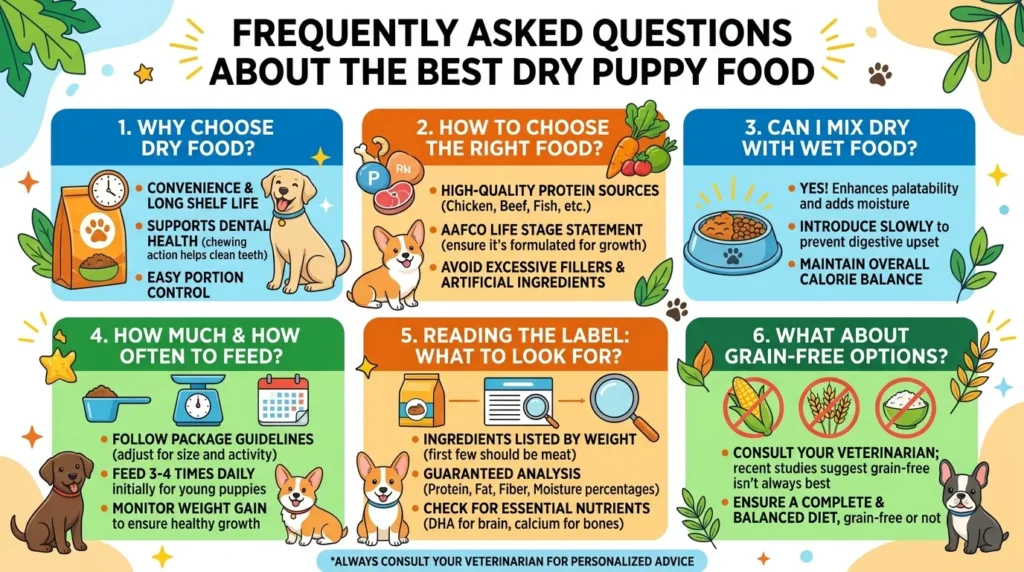
The timing depends entirely on your puppy’s expected adult size. Small breed puppies typically transition to adult food at 10–12 months. Medium breed puppies usually switch at 12 months. Large and giant breed puppies benefit from staying on puppy or large breed puppy food until 18–24 months because their skeletal development takes longer to complete. Always consult your vet for personalized timing advice based on your specific breed.
2. How much dry puppy food should I feed each day?
Daily portions depend on your puppy’s age, weight, expected adult size, and the specific food’s caloric density. Start with the feeding guidelines on the bag; they provide a reasonable baseline. However, every puppy is an individual. Therefore, monitor your puppy’s body condition monthly and adjust portions accordingly. Young puppies under 6 months need three meals daily. After 6 months, two meals per day suits most puppies well.
3. Is grain-free dry puppy food safe?
For most healthy puppies grain-free food carries more risk than benefit.The FDA’s ongoing investigation into a potential link between grain-free diets and dilated cardiomyopathy (DCM) is a genuine concern, especially during the critical developmental period. Unless your vet has specifically recommended grain-free for a diagnosed grain sensitivity or allergy, grain-inclusive formulas from trusted brands like Purina Pro Plan and Hill’s Science Diet are the safer, more clinically supported choice for puppies.
4. Can I mix wet food with the best dry puppy food?
Yes, mixing wet food into dry puppy food is perfectly fine and often beneficial. It adds moisture to your puppy’s diet, improves palatability for picky eaters, and makes the transition to solid food easier for very young puppies. However, adjust total portions when mixing to avoid overfeeding. Also, ensure the wet food you use carries the same AAFCO growth statement as your dry food “complete and balanced for growth” or “all life stages.”
5. What’s the best dry puppy food for large breed puppies specifically?
Purina Pro Plan Large Breed Puppy and Hill’s Science Diet Large Breed Puppy consistently earn the highest marks for large breed puppies from veterinary professionals. Both use specifically controlled calcium-to-phosphorus ratios to support appropriate skeletal development. Both carry feeding-trial-validated AAFCO compliance. Also, both brands have extensive nutritional research supporting their large breed formulations specifically. If you have a large breed puppy, a Labrador, Golden Retriever, German Shepherd, or similar, these two formulas are the safest, most clinically supported starting points.
6. How do I know if the dry puppy food I’m using is working?
Watch for these positive signs over an 8–12 week period: steady, appropriate weight gain for your breed’s growth curve, firm and consistent stools in reasonable volume, good energy levels and playful enthusiasm, a shiny developing coat, and bright, clear eyes. Negative signs chronic loose stools, excessive gas, poor coat condition, low energy, or unusually slow growth are worth discussing with your vet. These signals may indicate the current formula isn’t the best fit for your specific puppy.
7. Is Purina Pro Plan really the best dry puppy food vets recommend?
Yes Purina Pro Plan Puppy is one of the most consistently recommended puppy foods by veterinarians in the United States. The recommendation stems from the brand’s extensive peer-reviewed nutritional research, feeding-trial-validated AAFCO compliance, real chicken or salmon as the primary protein, DHA from fish oil for brain development, and a clean manufacturing safety record. Hill’s Science Diet Puppy receives equally strong veterinary endorsement. Both brands represent the gold standard in research-backed puppy nutrition and either one makes an excellent starting choice for most healthy puppies.
Give Your Puppy the Best Start Possible
Choosing the best dry puppy food is one of the most important decisions you’ll make in your dog’s entire life. The nutrients your puppy receives during these early months directly shape their adult health, energy, and longevity.
Start with a named protein first, look for DHA from fish oil, confirm the AAFCO growth statement, and match the formula to your puppy’s expected adult size. Brands like Purina Pro Plan Puppy and Hill’s Science Diet Puppy consistently deliver on every one of these criteria with research and feeding trials to back them up.
Also, always transition gradually, measure portions carefully, and check in with your vet regularly during the first year. Your puppy’s growth is happening fast and the right food makes every single day count.