
Introduction
Picking the right dry dog food brand feels overwhelming. There are hundreds of options on the shelf and every single bag claims to be the best. So how do you actually know which dry dog food brands are worth your money?
Here’s the thing: not all kibble is created equal. Some brands invest millions in nutritional research. Others spend that money on fancy packaging instead. As a result, your dog could be eating beautifully marketed food that doesn’t actually serve their health.
In my experience helping dog owners navigate pet food choices, the confusion is real and completely understandable. However, once you know what to look for, choosing the right brand becomes much easier.
This guide covers everything you need. You’ll discover the top dry dog food brands, how to evaluate them properly, common mistakes to avoid, and honest answers to the questions every dog owner asks. Let’s get started.
Why Dry Dog Food Brands Are Not All the Same
First, let’s talk about what separates a good dry dog food brand from a not-so-good one. Because, honestly, the price tag alone doesn’t tell the whole story.
Top dry dog food brands share a few key traits. They use named protein sources like chicken, beef, or salmon, not vague terms like “meat” or “animal protein.” They also invest in actual nutritional research. In addition, they manufacture food in quality-controlled facilities with strict safety standards.
Budget brands, however, often cut corners. They use cheaper fillers like corn, soy, and wheat as the main ingredients. As a result, your dog gets less nutrition per cup and produces more waste because the food is poorly digested.
What the AAFCO Label Actually Means
Ever noticed that small statement on dog food bags that mentions AAFCO? That label matters a lot. AAFCO stands for the Association of American Feed Control Officials. It sets minimum nutritional standards for pet food in the US.
However, there’s an important detail most owners miss. Look for bags that say “complete and balanced based on feeding trials” rather than just “formulated to meet” AAFCO standards. Feeding trials mean real dogs ate the food and showed positive health outcomes. Formulation-only claims are simply calculated on paper.
Therefore, always check this statement before buying any brand.
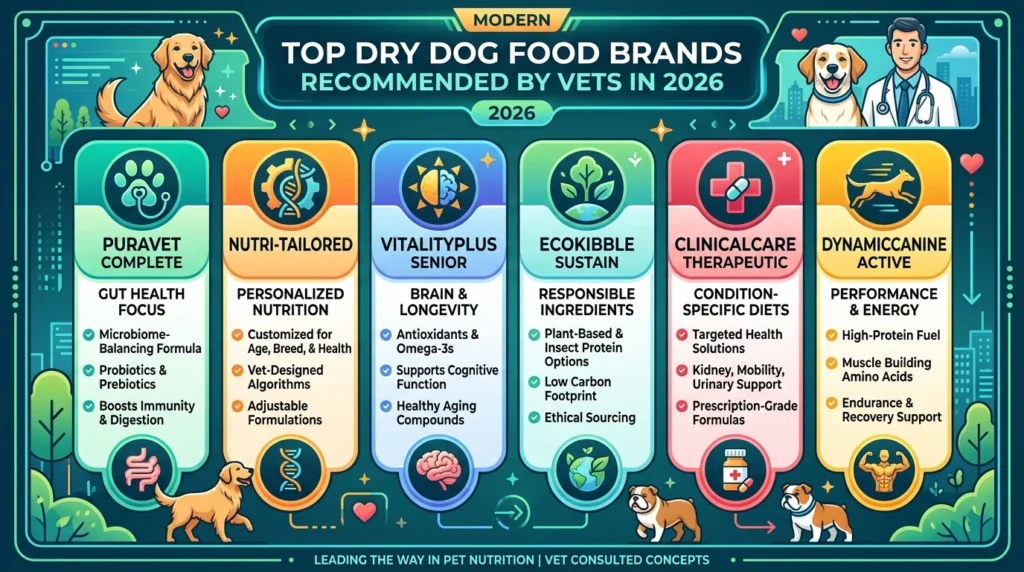
Top Dry Dog Food Brands Recommended by Vets in 2026
The Brands That Consistently Rise to the Top
After looking at research investment, ingredient quality, safety records, and veterinary endorsements, these dry dog food brands consistently lead the market.
Here’s a clear comparison so you can see exactly how they stack up:
| Brand | First Ingredient | AAFCO Basis | Recall Record | Daily Cost (50lb dog) | Vet Rating |
| Purina Pro Plan | Chicken / Salmon | Feeding Trials | Excellent | ~$2.50–$3.00 | ⭐⭐⭐⭐⭐ |
| Hill’s Science Diet | Chicken Meal | Feeding Trials | Excellent | ~$2.75–$3.25 | ⭐⭐⭐⭐⭐ |
| Royal Canin | Chicken By-product | Feeding Trials | Excellent | ~$3.00–$3.50 | ⭐⭐⭐⭐ |
| Purina ONE | Chicken | Formulation | Very Good | ~$1.75–$2.25 | ⭐⭐⭐⭐ |
| Orijen | Free-run Chicken | Limited | Excellent | ~$5.00–$6.50 | ⭐⭐⭐⭐ |
| Blue Buffalo | Deboned Chicken | Some | Good | ~$2.50–$3.00 | ⭐⭐⭐ |
| Iams Adult | Chicken | Formulation | Very Good | ~$1.50–$2.00 | ⭐⭐⭐ |
Purina Pro Plan The Overall Leader
Purina Pro Plan earns the top spot across almost every evaluation category. Real chicken or salmon leads every major formula. The brand employs over 500 scientists and nutritionists. In addition, feeding trial validation backs their AAFCO compliance meaning real dogs confirmed the health outcomes.
Vets recommend it more consistently than almost any other brand. However, this recommendation isn’t driven by marketing, it’s driven by decades of published nutritional science.
Hill’s Science Diet The Clinical Champion
Hill’s Science Diet sits right beside Purina Pro Plan at the top. Their research partnerships with veterinary institutions are genuine and extensive. Also, their prescription diet range Hill’s Prescription Diet covers kidney disease, heart conditions, food allergies, and more.
For dogs with specific health conditions, Hill’s is often the first brand your vet will mention. Therefore, if clinical validation is your priority, Hill’s belongs in your top two.
Royal Canin Best for Breed-Specific Needs
Royal Canin takes a different approach. Instead of general adult formulas, they create breed-specific and size-specific dry dog food. For example, there are formulas specifically for Labrador Retrievers, French Bulldogs, and German Shepherds.
This precision nutrition approach earns strong veterinary respect. However, it works best for purebred dog owners whose breeds have well-documented health predispositions.
Purina ONE Best Mid-Range Value
Not everyone can stretch to premium pricing and that’s completely fine. Purina ONE delivers real chicken or beef as the first ingredient, no corn or wheat filler, and solid protein levels at a genuinely accessible price. As a result, it’s my top recommendation for budget-conscious owners who still want named-protein-first nutrition.
Pro Tip: Calculate your true daily feeding cost not the bag price. Divide the bag price by how many days it lasts for your dog’s weight. Premium brands often cost less per day than you’d expect, especially since higher-quality food requires smaller portions.
[Best Dog Food Brands to Buy for Your Dog in 2026]
How to Choose the Right Dry Dog Food Brand for Your Dog
A Step-by-Step Evaluation Process
Choosing between dry dog food brands doesn’t have to be guesswork. Follow these steps and you’ll make a confident, informed decision every time.
- Start with the life stage. Puppy, adult, and senior formulas are nutritionally different. Always match the food to your dog’s actual life stage, not what’s convenient or cheapest.
- Read the first five ingredients. These make up the bulk of what’s in the bag. Therefore, you want to see a named animal protein chicken, beef, salmon within the first two ingredients. Corn or soy in the top five signals a filler-heavy formula.
- Find the AAFCO statement. Look for “complete and balanced based on feeding trials.” This single line tells you more about a brand’s nutritional commitment than any front-of-bag claim.
- Check the FDA recall database. Visit fda.gov and search your chosen brand. One recall isn’t necessarily alarming. However, a pattern of serious contamination events is a clear red flag.
- Consider your dog’s specific needs. Does your dog have a sensitive stomach? Skin issues? Weight problems? Joint pain? Most top brands offer targeted formulas for each of these. Also, always consult your vet before changing foods if your dog has a diagnosed health condition.
- Compare daily feeding cost not bag price. A $65 bag lasting 45 days costs about $1.44 per day. A $32 bag lasting only 20 days costs $1.60 per day and often delivers less nutrition. Therefore, daily cost gives a much clearer picture of true value.
- Plan a proper transition. Mix 25% new food with 75% old food for the first few days. Then gradually shift the ratio over 7–10 days. This prevents digestive upset that can make a great food seem like the wrong choice.
Matching the Brand to Your Dog’s Size
Small Breed Dogs
Small breeds burn more calories per pound than large dogs. As a result, they need calorie-dense formulas with smaller kibble sizes. Brands like Purina Pro Plan Small & Toy Breed and Royal Canin Small Adult are specifically designed for this.
Large Breed Dogs
Large breeds need carefully managed calcium and phosphorus levels especially during puppyhood. Brands like Hill’s Science Diet Large Breed and Purina Pro Plan Large Breed address these unique skeletal and joint needs directly.
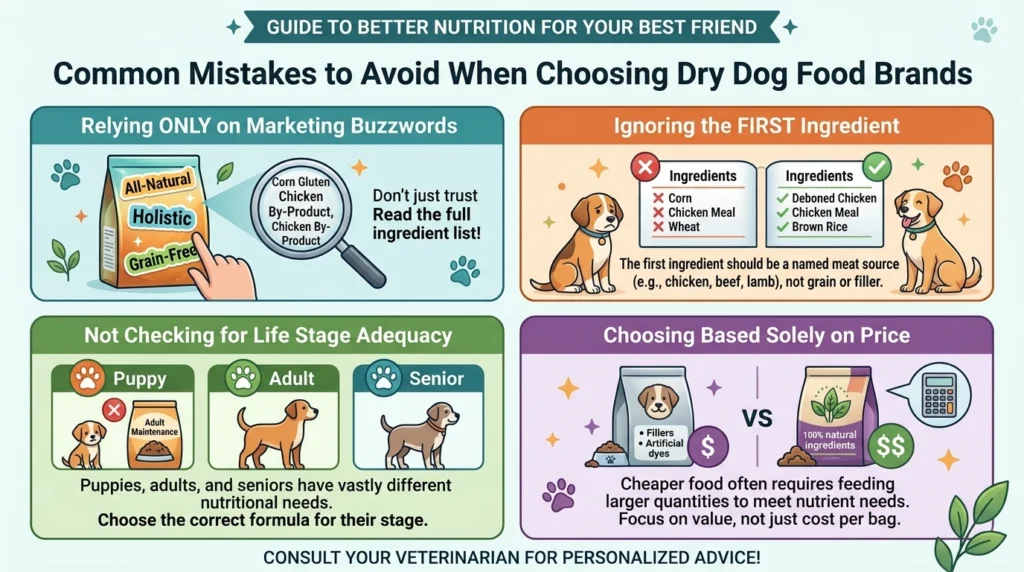
Common Mistakes Dog Owners Make When Choosing Dry Dog Food Brands
Mistake 1 Choosing Grain-Free Without a Medical Reason
Grain-free has been heavily marketed as the healthier choice. However, since 2018, the FDA has been investigating a potential link between grain-free diets and dilated cardiomyopathy (DCM) , a serious heart condition. Unless your vet specifically recommends grain-free for a diagnosed reason, grain-inclusive formulas are the safer default.
Mistake 2 Trusting Front-of-Bag Language
Words like “natural,” “holistic,” “premium,” and “human-grade” are largely unregulated in pet food labeling. Therefore, they mean very little nutritionally. Always flip the bag and read the actual ingredient list and AAFCO statement instead.
Mistake 3 Switching Brands Too Frequently
Reading about dog food can become a rabbit hole. However, constantly switching your dog’s food disrupts gut microbiome stability and makes it impossible to assess whether any food is genuinely working. Find a quality brand your dog thrives on then stick with it.
Mistake 4 Ignoring Expiration Dates
Dry dog food goes stale after opening typically within six weeks. Also, fat in kibble goes rancid over time, which degrades nutritional value and can upset your dog’s stomach. Always check the best-by date before buying, and store food properly in a sealed container.
Premium dry dog food brands are more calorie-dense and digestible. As a result, your dog needs smaller portions than the bag guidelines suggest for a lower-quality food. Always measure portions precisely weight, not volume to prevent gradual weight gain.
Frequently Asked Questions About Dry Dog Food Brands
1. Which dry dog food brands do vets recommend most?
Purina Pro Plan and Hill’s Science Diet are the two most consistently recommended dry dog food brands by veterinarians across the United States. Both carry feeding-trial-validated AAFCO compliance, extensive peer-reviewed research backing, and clean safety records. Royal Canin ranks third especially for breed-specific and condition-specific needs. These recommendations reflect nutritional science, not marketing relationships. However, always ask your own vet for a recommendation tailored to your specific dog’s health profile.
2. Are expensive dry dog food brands always better?
Not necessarily though there is generally a quality correlation as you move up price tiers. Purina ONE, for example, delivers genuinely solid nutrition at a mid-range price. The most useful metric is daily feeding cost relative to nutritional quality delivered. Also, a more digestible premium food often requires smaller portions which can narrow the cost gap significantly compared to cheaper, less digestible alternatives.
3. How do I know if a dry dog food brand has been recalled?
Visit the FDA’s official pet food recall database at fda.gov/animal-veterinary. Search your brand name and review the full recall history. Also, sign up for FDA email recall alerts. It takes two minutes and means you’ll be notified directly if any brand has a safety issue. Don’t rely solely on news coverage or pet store staff for this information.
4. Can I mix two different dry dog food brands together?
You can, but there’s rarely a nutritional reason to do so if each food is already complete and balanced. Mixing also makes it harder to identify the cause if your dog develops a food sensitivity. However, mixing is perfectly appropriate during a food transition gradually introducing the new brand over 7–10 days. If you’re mixing for variety, just ensure both foods are appropriate for your dog’s life stage and adjust total portions to avoid overfeeding.
5. What dry dog food brand is best for a dog with a sensitive stomach?
Purina Pro Plan Sensitive Skin & Stomach (Salmon & Rice) is the most consistently recommended option for digestive sensitivity. Salmon as the primary protein reduces sensitivity likelihood. Rice provides a gentle, easily digestible carbohydrate base. In addition, prebiotic fiber supports healthy gut bacteria balance. Hill’s Science Diet Sensitive Stomach & Skin is equally strong clinically. For persistent digestive issues, always consult your vet; ongoing symptoms may indicate an underlying condition rather than a simple food sensitivity.
6. Are grain-free dry dog food brands safer for dogs with allergies?
Not automatically. True grain allergies are actually less common in dogs than most people assume. The most frequent food allergens are specific proteins, beef, chicken, and dairy not grains broadly. Furthermore, grain-free brands have been associated with potential cardiac concerns in ongoing FDA research. Unless your vet has confirmed a grain allergy through a proper elimination diet, grain-inclusive formulas are the safer, more clinically supported choice for most dogs.
7. How often should I reassess my dog’s dry food brand?
Review your dog’s food at every annual vet visit. Your dog’s nutritional needs shift significantly across life stages. Also, health conditions can develop over time that require formula adjustments. If your dog is showing signs like a dull coat, low energy, weight changes, or inconsistent digestion, those are signals worth discussing with your vet regardless of when the last review happened.
Making the Right Choice for Your Dog
Choosing between dry dog food brands doesn’t have to feel like a guessing game. Start with the life stage, read the ingredient list carefully, verify the AAFCO feeding trial statement, check the FDA recall history, and calculate your true daily feeding cost.
Brands like Purina Pro Plan, Hill’s Science Diet, and Royal Canin consistently earn the highest marks across every meaningful evaluation criterion. Purina ONE delivers outstanding mid-range value. All of these are genuinely reliable starting points for most healthy dogs.
Finally and most importantly loop your vet into the conversation. They know your dog’s individual health profile in a way no article can fully replicate. A quick conversation at your next appointment can confirm whether your chosen brand and formula is the right fit.